
Free Printable Worksheets for Homeschool, Teachers and Tutors
Quick answer
A good free worksheet practises one clear skill, matches the child's level, leaves room to write and comes with an answer key. Start one level below where you think the child is, step up when they get most answers right without help, and keep sessions short: 5–10 minutes for ages 2–5 and 10–20 minutes for ages 5–10. Use worksheets for practice and review after you have taught something, not instead of teaching it.
Free printable worksheets are everywhere, and that is both the good news and the problem. A quick search brings up thousands of pages, but a worksheet that looks cheerful isn't always a worksheet that helps a child learn.
This guide is for the three groups who print the most worksheets: homeschool parents, teachers and tutors. It covers how to tell a useful worksheet from a time-filler, how to pick the right level, how to fit worksheets into a week, and the mistakes that make children dread them.
What makes a printable worksheet worth printing
Before you press print, check the page against this short list. A good worksheet:
- Practises one clear skill. "Counting in tens to 50" is a skill. "Fun maths page" is not. If you can't say in a few words what the child is practising, neither can they.
- Matches the child's level. Too easy and they learn nothing new; too hard and they guess or give up. The sweet spot is work they can mostly do, with a little stretch.
- Starts with something familiar. A quick warm-up from earlier work helps children settle in and keeps old skills fresh.
- Leaves room to write. Young children write big. Answer boxes that are too small cause messy work and frustration, not learning.
- Has an answer key. It saves time, and it lets you check work the same day while the child still remembers it.
- Is calm on the page. Clear pictures, plenty of white space and no clutter. Decoration should help the task, not compete with it.
- Prints well. It fits your paper (A4 or US Letter) and still makes sense in black and white if your printer is low on colour.
- Says how you may use it. Good sites tell you whether you can copy pages for your own children or class.
If a worksheet ticks most of these boxes, it is worth a child's time.
The same skill at three levels
One of the most useful things a worksheet collection can offer is the same skill at more than one level. Children in the same family, or the same class, are rarely at the same point, and the same child can be confident in one topic and shaky in the next.
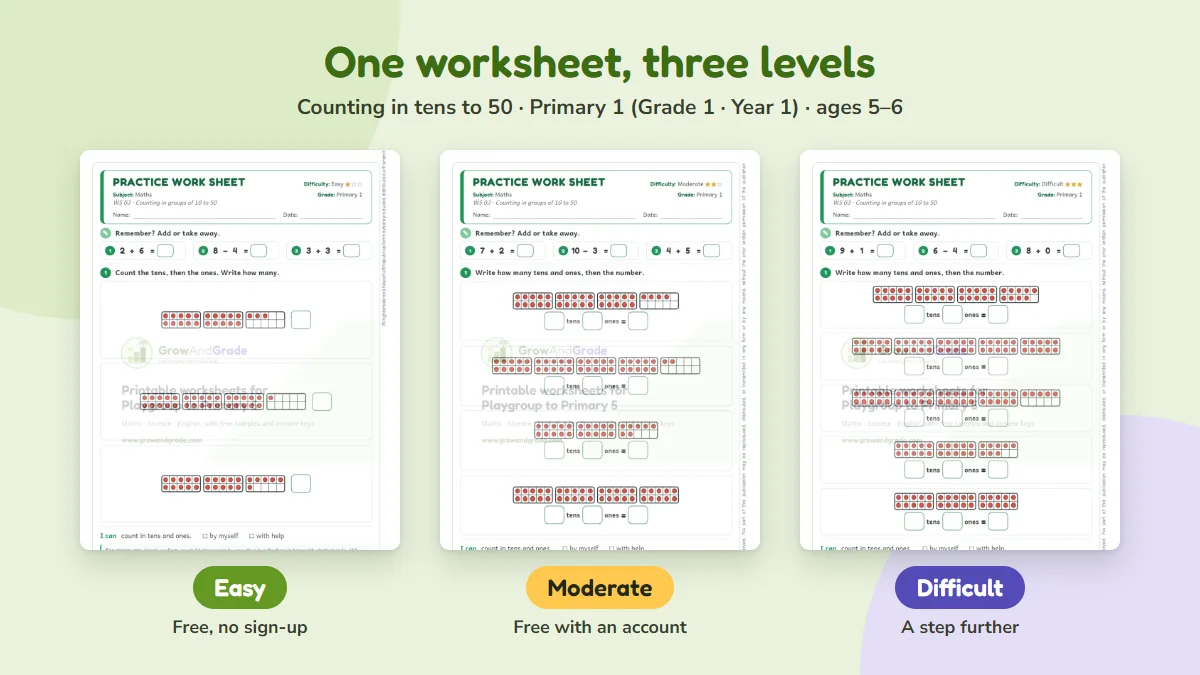
At GrowAndGrade every worksheet comes in three levels:
| Level | Who it suits | Access |
|---|---|---|
| Easy | A first try at a skill, younger children in the age range, or a confidence boost | Free, no sign-up |
| Moderate | Typical practice for the grade | Free with an account |
| Difficult | Children who find Moderate comfortable and need a stretch | $0.99, or in a pack |
How to choose: start one level below where you think the child is. If they get nearly everything right without help, move up next time. If they get fewer than about half right, go back down and practise with real objects or examples first. Our guide to choosing the right level explains this in more detail.
Which grade? A quick guide for families in different countries
Grade names differ around the world, which makes searching for worksheets confusing. Ages are the most reliable guide. This is how our grades line up with the US and UK school years (it's an approximate guide, because school starting ages differ):
| GrowAndGrade | United States | United Kingdom (England) | Typical age |
|---|---|---|---|
| Playgroup | Preschool / toddler | Pre-school | 2–3 |
| KG1 | Pre-K | Nursery | 3–4 |
| KG2 | Kindergarten | Reception | 4–5 |
| Primary 1 | Grade 1 | Year 1 | 5–6 |
| Primary 2 | Grade 2 | Year 2 | 6–7 |
| Primary 3 | Grade 3 | Year 3 | 7–8 |
| Primary 4 | Grade 4 | Year 4 | 8–9 |
| Primary 5 | Grade 5 | Year 5 | 9–10 |
Our ages follow the UK school year; in the US, children are usually about a year older in each grade. If your child is between two grades, choose by what they can do, not by their birthday. Our guide to what each grade covers lists the main skills for every year.
For homeschool parents: worksheets as part of a routine
Worksheets work best in homeschooling as short, regular practice after you have taught something, not as the whole lesson. Teach the idea with real things first, such as counters, coins, books or a walk outside, then use a worksheet to practise and to see what has stuck.
How long? Short and regular beats long and occasional:
| Age | One session | How often |
|---|---|---|
| 2–5 (Playgroup to KG2) | 5–10 minutes | Most days, stop while it's still fun |
| 5–7 (Primary 1–2) | 10–15 minutes | One worksheet a day |
| 7–10 (Primary 3–5) | 15–20 minutes | One or two worksheets a day |
A simple week might rotate subjects so each one comes round regularly:
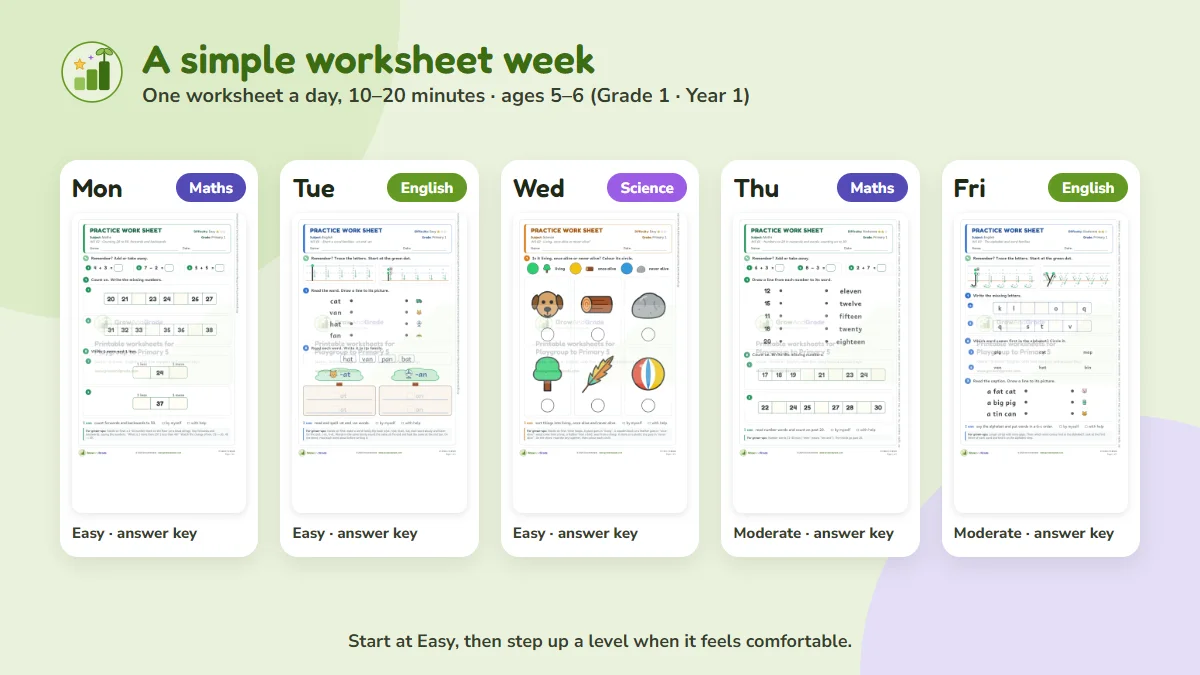
A few habits make this much easier:
- Print the week on Sunday. Put the five sheets in a folder in order. No hunting for the printer on a busy morning.
- Mark it together, straight away. Use the answer key while the work is fresh. Ask "how did you get that?" for one right answer and one wrong one.
- Keep a simple portfolio. A binder with a dated sheet per week shows progress over the year. Our free progress tracker puts it all on one page. Many homeschool families keep one anyway, and some places expect records, so check what your state or country asks for.
- Mix in hands-on work. Sorting real objects, measuring in the kitchen and reading together all count. A worksheet is one tool, not the curriculum.
- Revisit older skills. Every few weeks, repeat an Easy sheet from earlier. Quick success builds confidence, and reviewing old skills is one of the most reliable ways to make learning stick.
For teachers: one skill, three levels, one lesson
In a class of thirty, children are spread across a wide range. Worksheets with three levels let everyone practise the same skill while working at the right challenge, so you can teach one lesson and still differentiate.
- Same title, different level. Children don't feel singled out when everyone has "Counting in tens to 50"; they just have a different version.
- Starters and exit checks. A short warm-up shows what the class remembers; a few questions at the end show who needs help tomorrow.
- Early finishers. Keep a few Difficult sheets ready for children who finish quickly, so they can stretch instead of waiting.
- Homework. Send Easy or Moderate sheets home for practice. Homework should be work children can do on their own, not new learning.
- Supply cover. A folder of ready worksheets for each topic makes a lesson plan for a cover teacher simple.
For tutors: find the gap, then close it
Tutors usually have a short time with each child, so worksheets need to earn their place.
- Find the starting point. In the first session, try the Easy and Moderate versions of a key skill. Where the child starts to struggle is where to begin.
- Teach, then practise in the session. Explain the idea, do one example together, then let the child try a few questions while you watch how they think.
- Set short practice between sessions. One or two sheets a week, at a level the child can do alone. Parents can check them with the answer key.
- Show progress. Moving from Easy to Difficult on the same skill is visible progress that children and parents both understand. A one-page progress tracker makes it easy to share.
- Use model papers before tests. A practice paper in the same style as the real test helps children manage time and nerves.
Common mistakes to avoid
- Using worksheets to teach a brand-new idea. Teach first, practise second.
- Too many sheets in one sitting. One focused sheet is better than five rushed ones.
- Staying at the same level for weeks. If it's easy, move up; if it's frustrating, move down.
- Marking days later. Feedback works best while the child still remembers the work.
- Only correcting, never asking. "Show me how you did this one" teaches more than a cross.
- Printing everything you find. Follow a sequence that builds skills step by step, rather than random pages.
When free is enough, and when to pay
Free worksheets can carry a family or a class a long way, especially for practice and review. Paid sets are worth it when you want a complete sequence that builds term by term, harder levels for children ready for a stretch, and packs that save you searching for each page.
At GrowAndGrade every Easy worksheet is free with no sign-up, every Moderate worksheet is free with an account, and Difficult worksheets and topic packs are low-cost. Start with the free worksheets, find your child's grade, and step up when they're ready.
Questions parents ask
Are free printable worksheets enough for homeschooling?
For practice and review, often yes. They work best alongside teaching with real objects, reading together and conversation. Many families use free worksheets for most practice and buy sets for subjects where they want a complete step-by-step sequence.
How many worksheets should a child do a day?
Usually one. For ages 2–5, one short page of 5–10 minutes is plenty. For ages 5–10, one or two pages of 10–20 minutes is enough. Stop while your child is still enjoying it.
Can teachers use free worksheets in the classroom?
Yes. Our worksheets are licensed for personal, home and single-classroom use, so you can print as many copies as you need for your own class. Please share the link rather than the file with other teachers.
Which grade should I choose if my child is between two?
Choose by what your child can do, not by their age. Try the Easy level of the younger grade; if it's comfortable, try the Moderate level, then move to the older grade.
Will the worksheets print on US Letter paper?
Yes. Every worksheet is a print-ready PDF that fits both A4 and US Letter paper.
Do the worksheets come with answers?
Yes, the worksheets come with answer keys, so you can mark work the same day.
Sources and further reading
- Barak Rosenshine, Principles of Instruction: Research-Based Strategies That All Teachers Should Know, American Educator (2012)
- Education Endowment Foundation, Teaching and Learning Toolkit: Feedback
- Education Endowment Foundation, Teaching and Learning Toolkit: Homework
- Department for Education (England), The national curriculum
- GrowAndGrade curriculum maps for Playgroup to Primary 5