
How to Teach Addition to Young Children
Quick answer
Start with real objects: put two groups of toys together and count how many altogether. Then teach counting on from the bigger number, then number bonds to 10. Only bring in the + and = signs once the idea makes sense with objects. Fingers, number lines and drawings are all fine along the way.
Addition looks simple to us, but for a young child it is a big idea: two separate groups can become one bigger group, and you can work out how many there are without starting again from one.
Children get there in stages. If you follow those stages, addition usually feels easy. If you jump straight to written sums like 3 + 4 = ?, many children end up memorising rather than understanding.
Before addition: counting properly
Addition is built on counting, so it's worth checking a few things first:
- Can your child count objects by touching each one once?
- Do they know that the last number they say is how many there are?
- Can they see small amounts (up to about five) without counting, like the dots on a dice?
If these are still wobbly, spend more time on counting. It isn't a step backwards; it's the foundation.
Step 1: Putting groups together
Start with things your child can touch. Two teddies here, three teddies there. Push them together: how many teddies now?
At first your child will count them all from one. That's fine. Use words like altogether, more and how many now so the language of adding becomes familiar.
Building blocks are one of the best things to start with. Sit down together, pick out a handful of blocks and count them one by one, touching each block as you say the number. Coloured blocks work especially well: "two red blocks and three blue blocks" is easier for a young child to picture and remember than five blocks that all look the same. Choose chunky, square or brick-shaped blocks rather than small round ones or beads. Little round pieces are easy for young children to put in their mouths and swallow.
Step 2: Counting on
The next step is a big one: instead of counting everything again, start from the first number and count on.
"You have 5 cars. Here are 2 more. Start at 5... 6, 7. Seven cars!"
Children soon learn that it is quicker to start from the bigger number: for 2 + 6, start at 6.
Step 3: Number bonds
Number bonds are pairs of numbers that make a total, like 3 and 2 make 5, or 7 and 3 make 10. Knowing the bonds to 10 by heart makes almost all later maths easier.
Fun ways to practise:
- Hide some of 10 buttons under a cup: "There are 6 out. How many are hiding?"
- Use ten-frames (a box of 2 rows of 5): how many full, how many empty?
- Play "make 10" with playing cards.
Step 4: The symbols
Only now bring in the + and = signs. Show that 3 + 2 = 5 is just a short way of writing "3 and 2 more make 5". Keep using objects or drawings alongside the numbers for a while.
Step 5: Number lines and bigger numbers
A number line helps children add bigger numbers by jumping along: start at 8, jump 5, land on 13. From here, children move on to adding within 20, then two-digit numbers, then written column addition in later primary.
How addition grows, grade by grade
Here is the path our maths worksheets follow.
| Grade | Addition focus |
|---|---|
| KG1 | Counting to 10, adding within 5 with pictures and objects |
| KG2 | Counting on, number bonds to 5 and 10, adding to 10 on a number line, word problems |
| Primary 1 | Adding within 20, fact families, adding two-digit numbers |
| Primary 2 | Mental calculation and two-digit adding |
| Primary 3 | Column addition with numbers to 1,000 |
| Primary 4–5 | Column addition with 4-, 5- and 6-digit numbers, checking with estimation |
Is counting on fingers OK?
Yes. Fingers are a natural tool, and they help children see numbers. Over time, as number bonds become familiar, children use them less. There's no need to ban them.
Common mistakes to avoid
- Starting with written sums. Objects first, symbols later.
- Counting the first number twice when counting on.
- Rushing past number bonds. They are worth a lot of practice.
- Only practising on paper. Use snack time, toys, steps and coins too.
- Timing young children. Speed comes naturally once understanding is secure.
Printable worksheets
Practise this at home or in class. Free worksheets come first, and most come with an answer key.
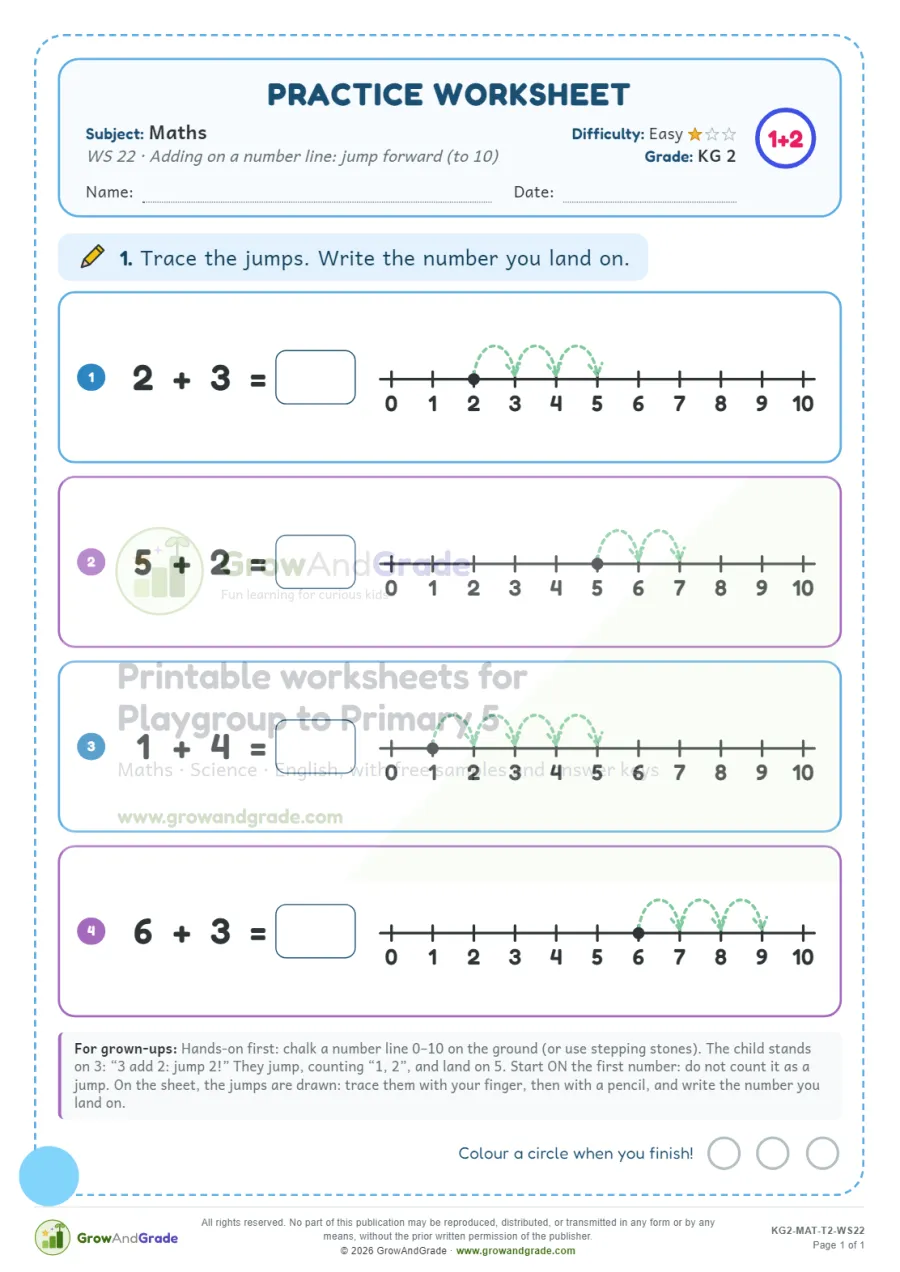
Adding on a number line: jump forward (Easy)
Free download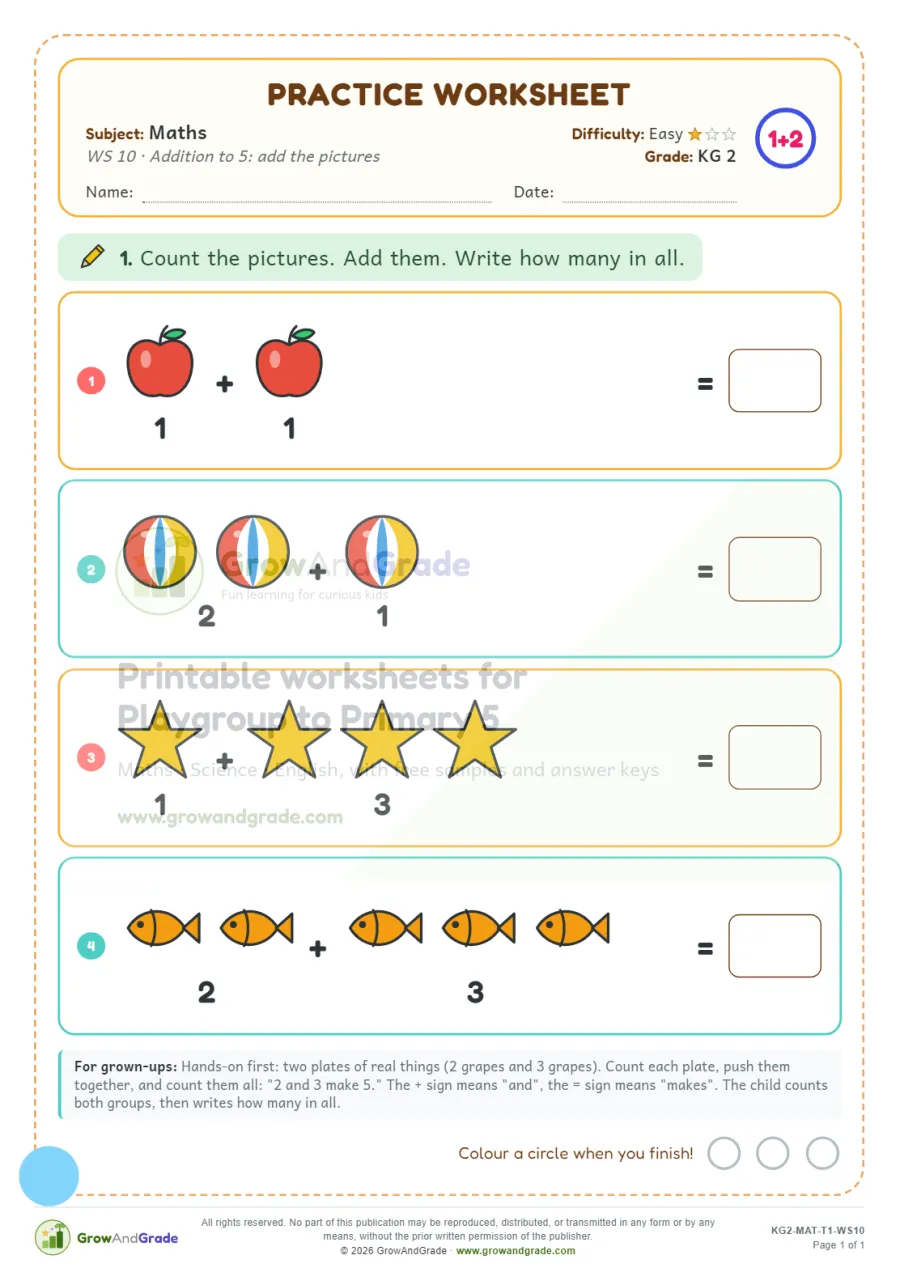
Addition to 5: add the pictures (Easy)
Free download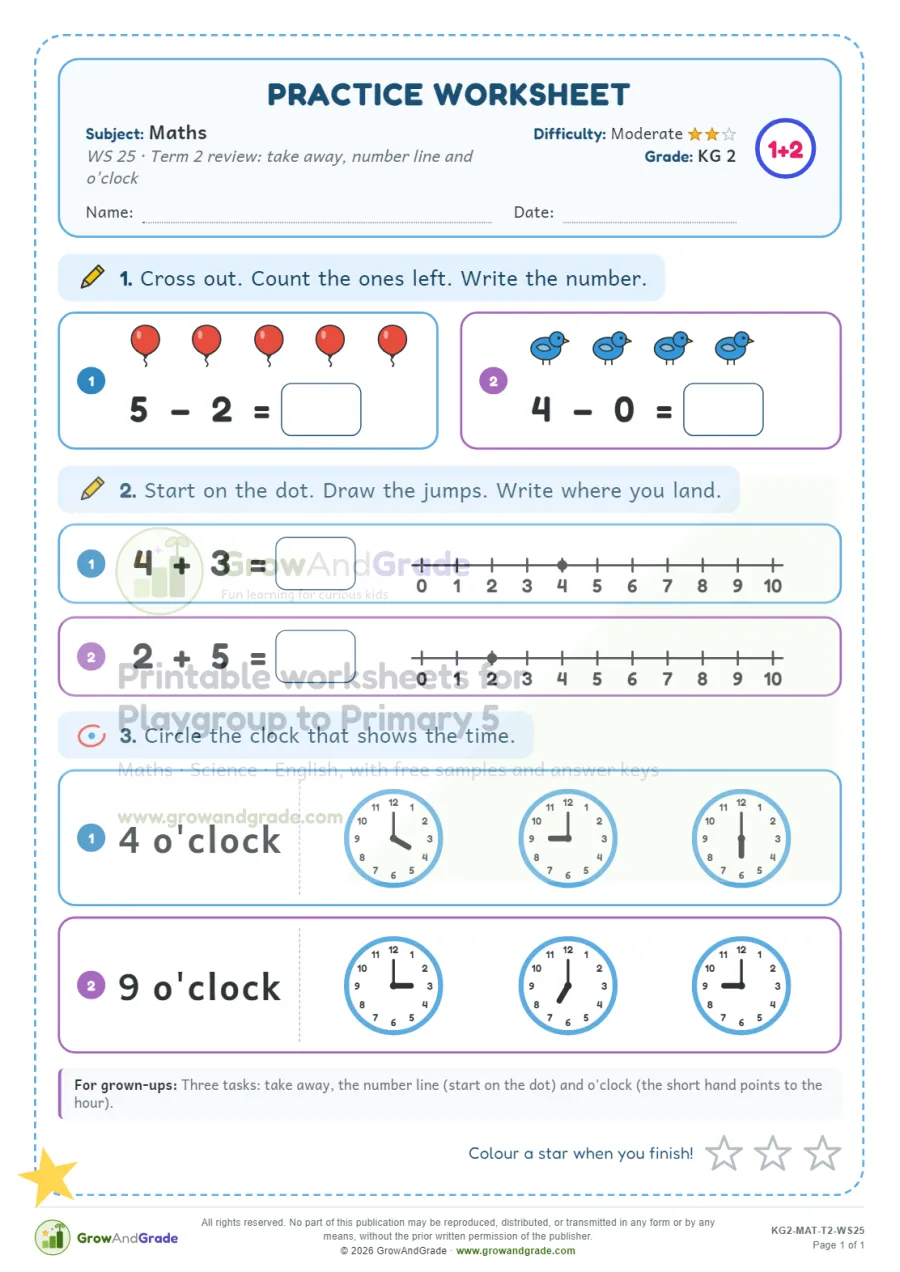
Term 2 review: take away, number line and o'clock (Moderate)
Free with account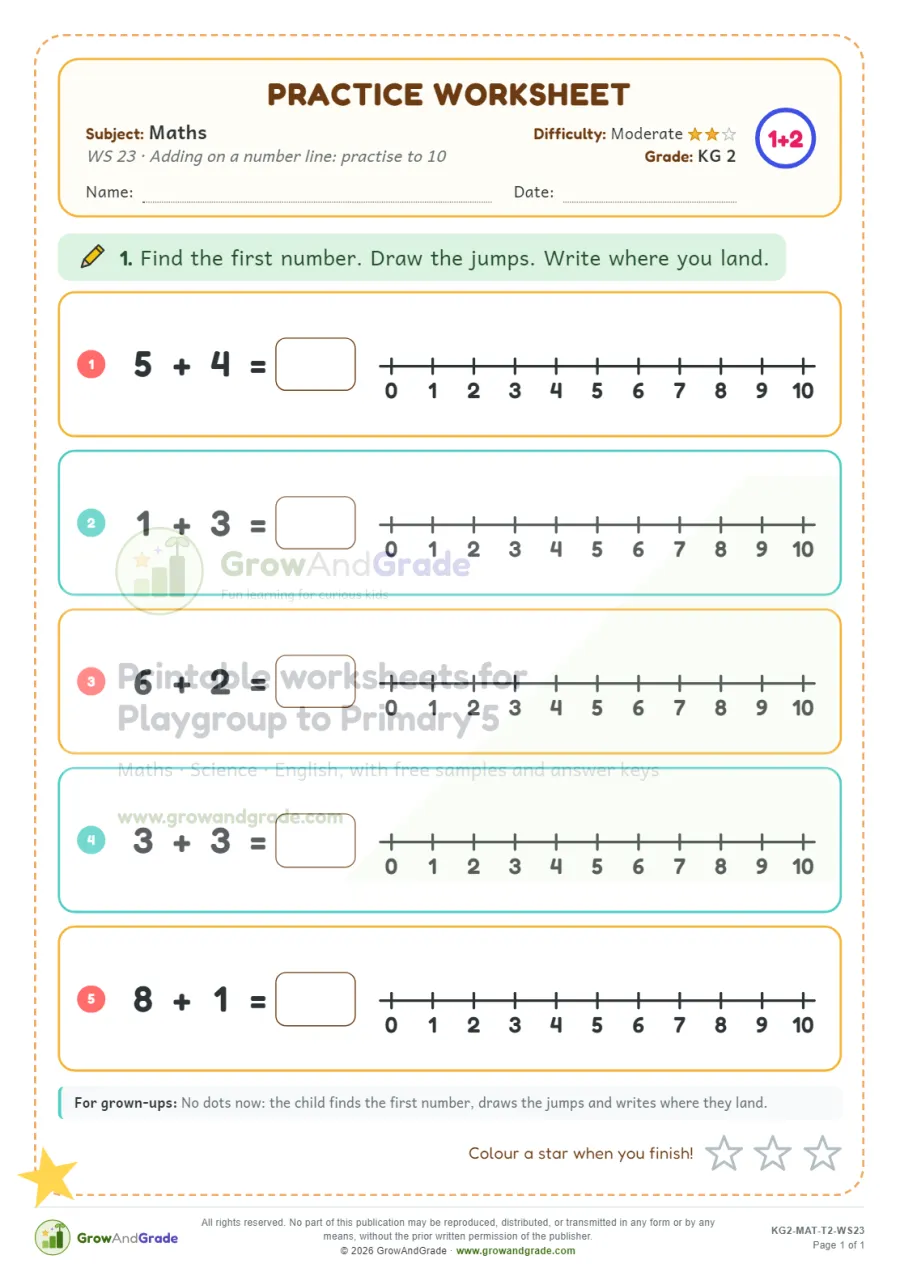
Adding on a number line: practise to 10 (Moderate)
Free with account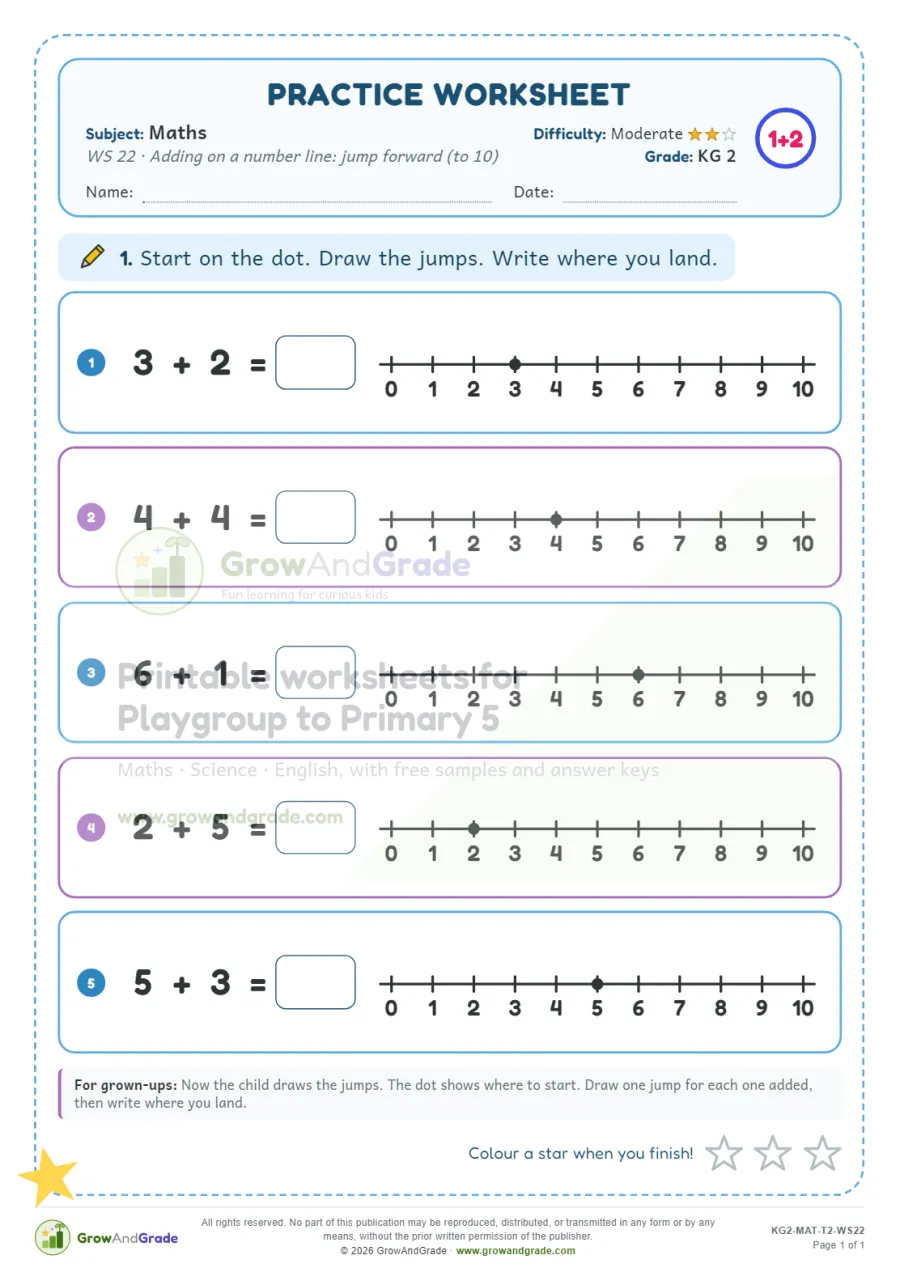
Adding on a number line: jump forward (Moderate)
Free with account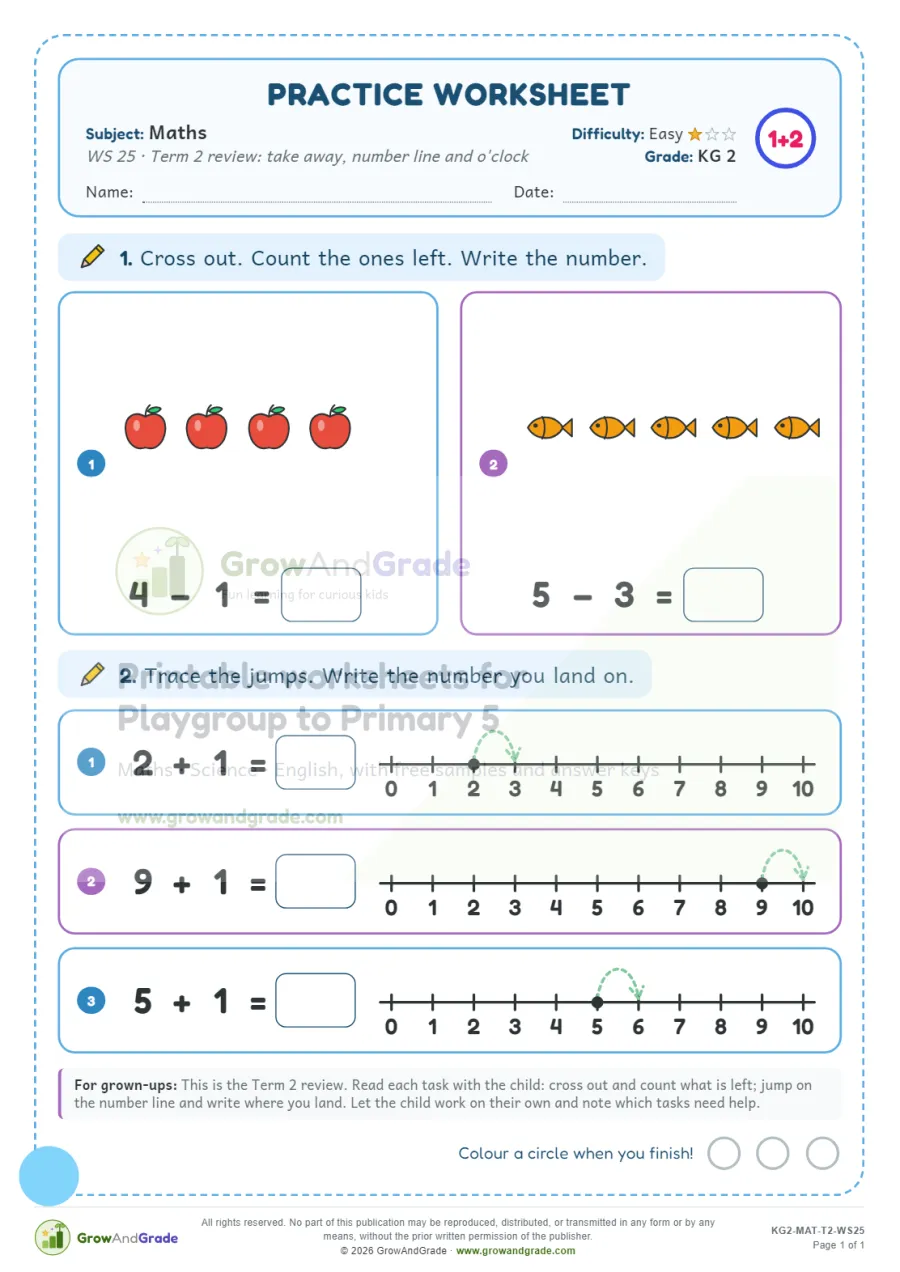
Term 2 review: take away, number line and o'clock (Easy)
Free downloadQuestions parents ask
At what age can children start learning addition?
Many children start combining small groups of objects around four. Written sums usually come later, around five or six, once counting is secure.
What are number bonds to 10?
The pairs that make 10: 0 and 10, 1 and 9, 2 and 8, 3 and 7, 4 and 6, and 5 and 5. Knowing them by heart makes adding and subtracting much quicker.
My child counts everything from one every time. How can I help?
Practise counting on with objects: say the first number, hide that group under a cloth, then count on with the rest. Seeing that the hidden group is still there helps.
Should my child learn addition facts by heart?
Eventually, yes, especially number bonds to 10 and doubles. But understanding comes first; facts stick better when children know what they mean.
When do children learn column addition?
Usually around Primary 3, once they understand place value (tens and ones). Learning it earlier without that understanding often leads to mistakes.
Sources and further reading
- Education Endowment Foundation, Improving Mathematics in the Early Years and Key Stage 1 (guidance report)
- Department for Education (England), Development Matters
- Cambridge Primary Mathematics curriculum framework (Cambridge University Press & Assessment)
- GrowAndGrade Maths curriculum maps for KG1 to Primary 5