
How to Teach Letter Sounds and Phonics to Young Children
Quick answer
Teach one sound at a time, using the pure sound ("sss", not "suh"). Start with s, a, t, p, i and n, which quickly make real words like sat, pin and tap. Once your child knows a few sounds, show them how to blend: say each sound, then push them together. Little and often, every day, works best.
Phonics is simply teaching children that letters stand for sounds, and that sounds blend together to make words. It is how most schools in the UK and many international schools teach early reading, and it works because it gives children a way to work out new words for themselves, rather than guessing or memorising.
The good news is that you don't need to be a teacher to help. A few minutes a day, done the right way, makes a real difference.
Letter names or letter sounds?
Children need both eventually, but for reading, sounds come first. The letter name "em" doesn't help a child read mum. The sound "mmm" does.
When you talk about letters at home, try to use the sound: "Look, that's a t (t-t-t) for tiger." Children usually pick up the names later from songs and everyday talk anyway.
Say the pure sound
This is the most useful tip in this whole article. Many of us say "suh" for s or "muh" for m. That extra "uh" makes blending much harder: "suh-a-tuh" doesn't sound like sat at all.
Try to keep the sounds clean:
- Stretchy sounds you can hold: sss, mmm, nnn, fff, lll.
- Bouncy sounds you say quickly and cut short: t, p, k, d. Say them as short as you can, almost a whisper.
Which sounds to teach first
Most phonics programmes start with a small group of letters that can make lots of simple words straight away. A common first set is s, a, t, p, followed by i, n, m, d. With just these eight sounds, children can read sat, pat, tap, pin, tin, sit, man, dad and more.
After that come the rest of the single letters, then sounds made with two letters (called digraphs), like sh, ch, th and ng.
Flash cards and letter blocks
You don't need anything fancy to practise sounds at home. Simple flash cards with one letter printed on each are perfect: hold one up, say the sound together, then let your child hold up a card for you to say. Mix in the sounds they already know so every session starts with a few easy wins.
Plastic block letters or magnetic letters are great too, because children can touch and move them. Lay out s, a and t, say each sound, then slide them together to make sat. Swap the s for a p and you have pat. Now swap the p and the t around and the same three letters make tap! Children love this little trick, and it shows them that the order of the letters really matters. Try pin and nip or top and pot too. Moving the letters with their own hands helps the idea of blending really click. For younger children, choose big, chunky letters rather than small ones that could be put in the mouth.
Blending: reading the word
Blending is the moment reading clicks. Your child says each sound, then pushes them together:
- Point to each letter and say its sound: s – a – t.
- Say them again a bit faster: s-a-t.
- Push them together: sat!
If your child gets stuck, say the sounds yourself and let them hear the word. Practise blending out loud during the day too: "Can you find your s-o-ck?"
Segmenting: spelling the word
Segmenting is blending backwards. You say a word and your child breaks it into sounds: dog is d – o – g. This is the skill they use to spell. Counting the sounds on fingers helps.
How phonics grows, grade by grade
Here is how our English worksheets build phonics over the early years.
| Grade | Phonics focus |
|---|---|
| Playgroup | Seeing and tracing letters, hearing the first sound in a word |
| KG1 | Forming every letter, beginning sounds, rhyming, first words such as the and is |
| KG2 | Short vowel words (CVC words like cat, pen, dog), digraphs sh, ch, th, ng, blends like st and fl, first sight words, reading a short sentence |
| Primary 1 | Vowel teams (ai, ee, oa), "magic e" words like cake, longer words and simple sentences |
Tricky words
Some very common words can't be sounded out easily: the, was, said, you. These are often called tricky words or sight words. Teach them a few at a time, and point out the part that is tricky: in said, the "ai" says "e".
Short and daily beats long and weekly
Ten minutes a day is far better than an hour on Saturday. A good session might be:
- Two minutes: quick review of sounds your child already knows.
- Three minutes: one new sound, with a picture and an action.
- Five minutes: blending a few words, or one worksheet together.
Common mistakes to avoid
- Adding "uh" to sounds. It makes blending much harder.
- Encouraging guessing from pictures. Pictures are lovely, but the goal is to read the letters.
- Moving on too fast. It's fine to spend a week on the same few sounds.
- Only using capital letters. Most of what children read is lower case.
- Making it a test. If your child is tired or upset, stop and try tomorrow.
Printable worksheets
Practise this at home or in class. Free worksheets come first, and most come with an answer key.
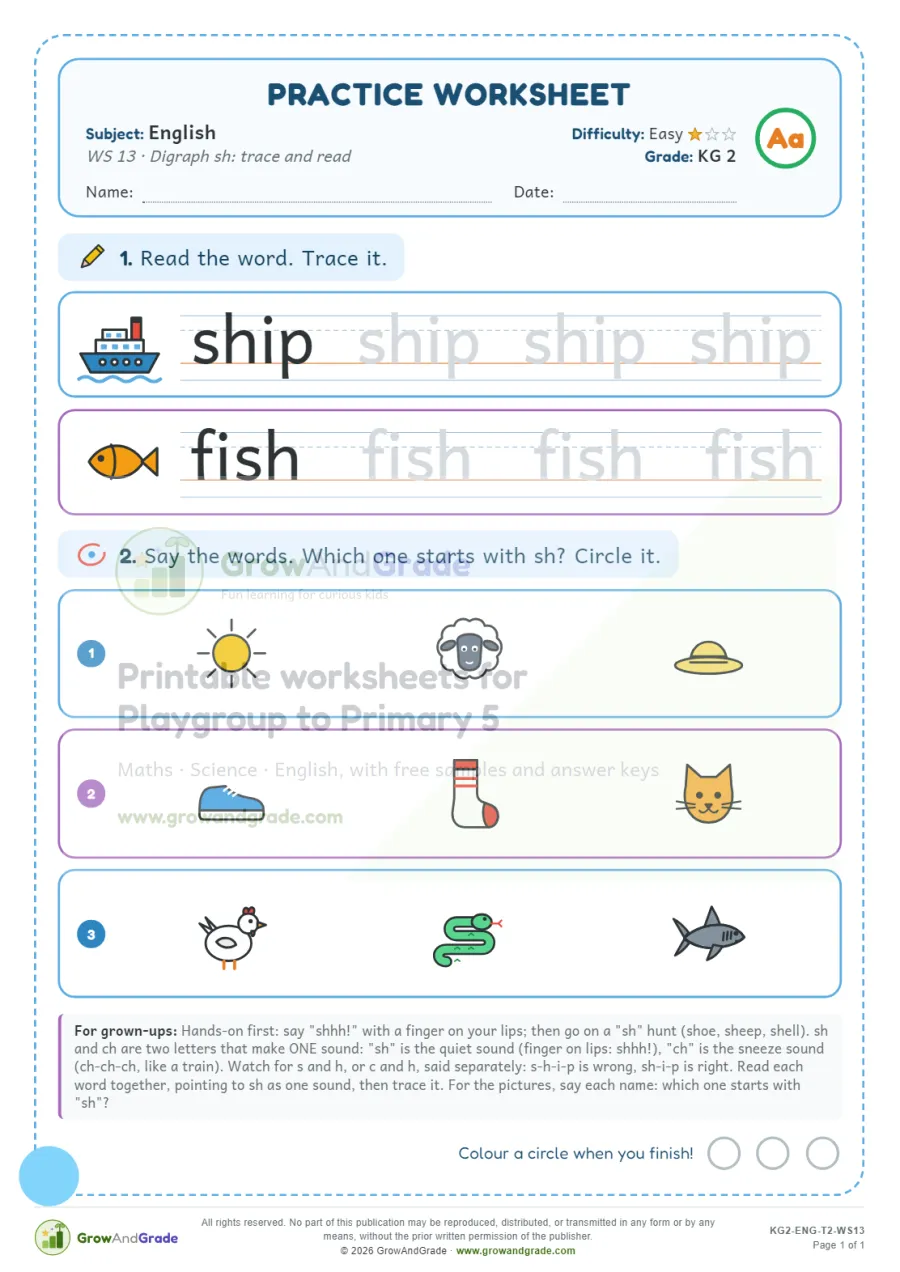
Digraph sh worksheet: trace and read sh words (Easy)
Free download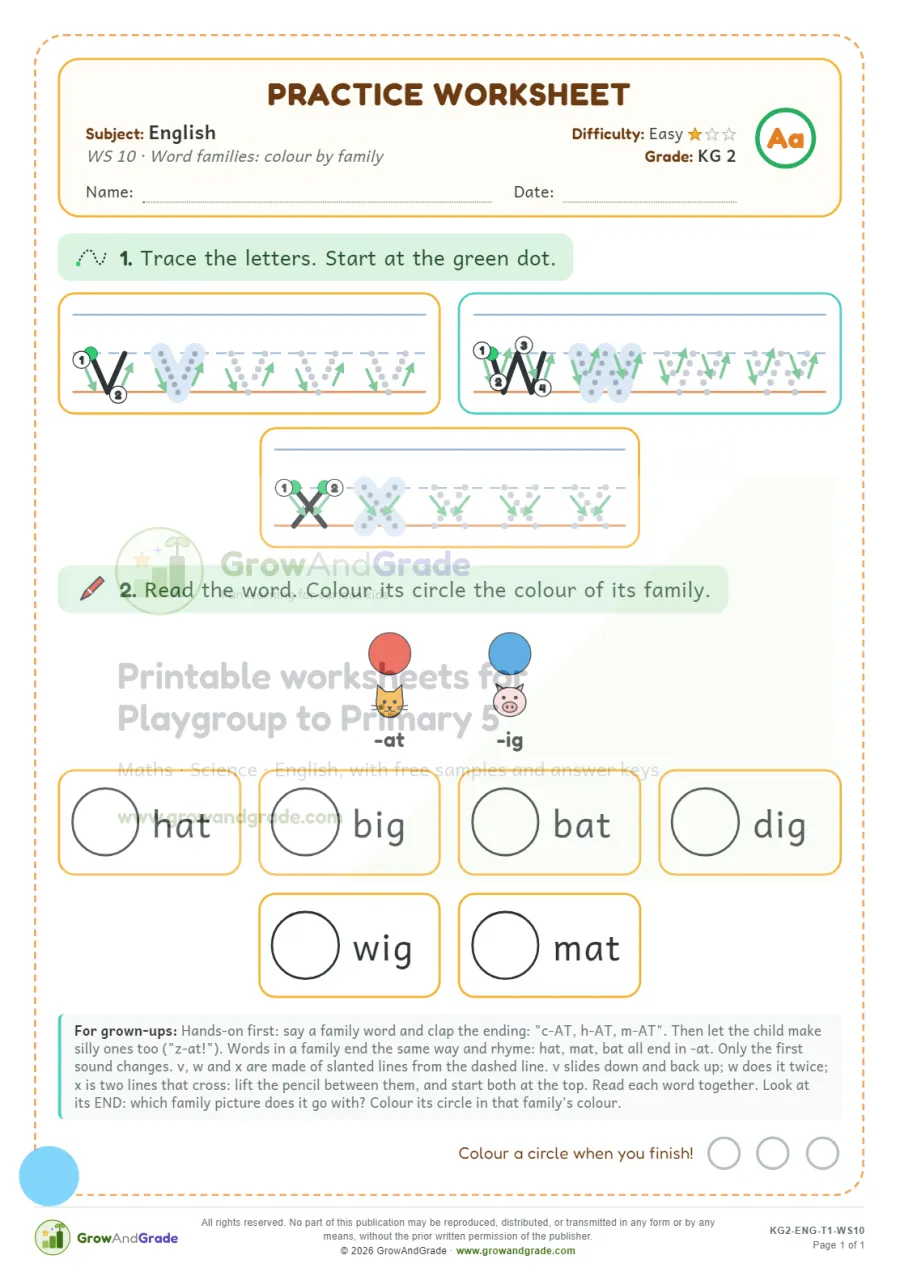
Word families: read and colour by family (Easy)
Free download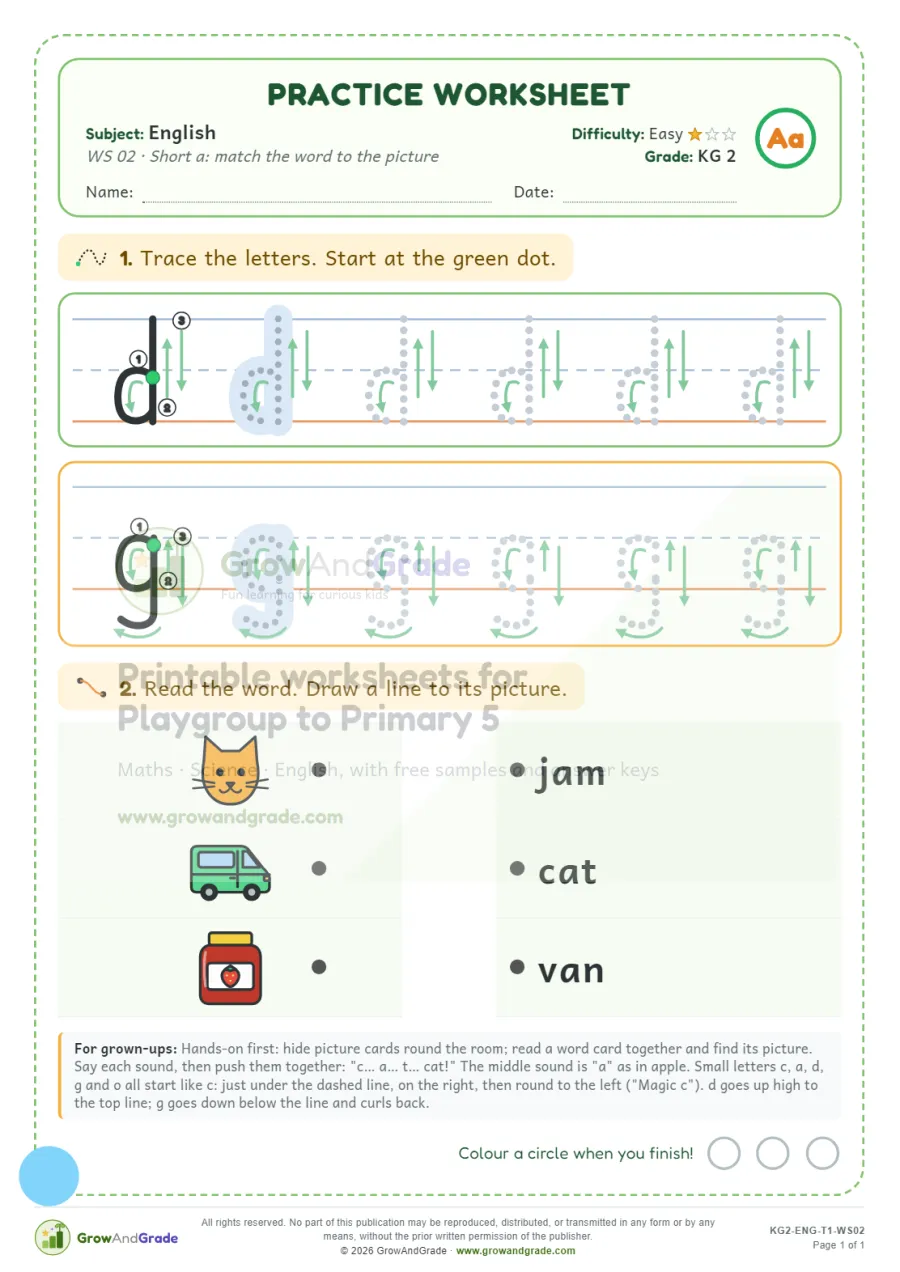
Short a words: match the word to the picture (Easy)
Free download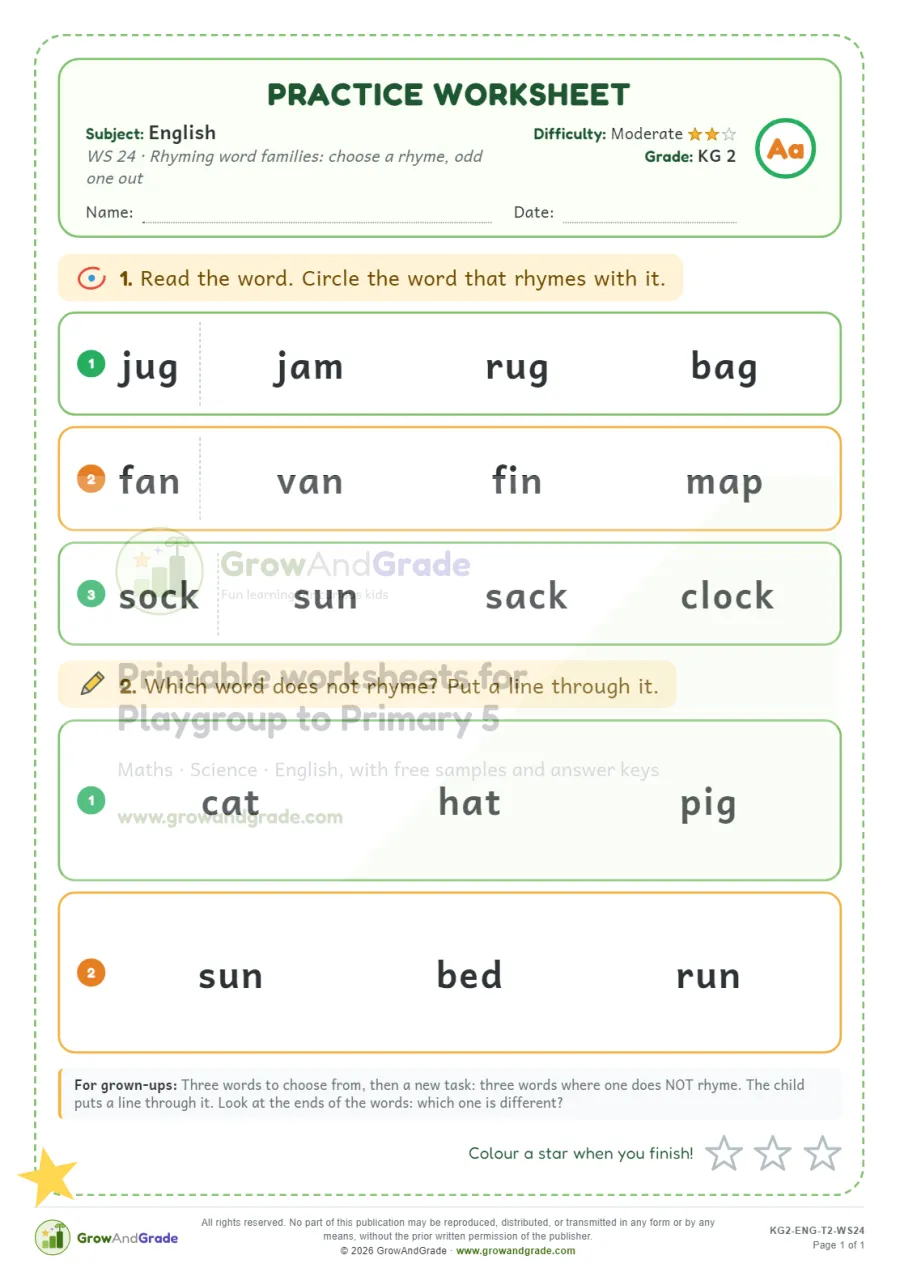
Rhyming word families: choose a rhyme (Moderate)
Free with account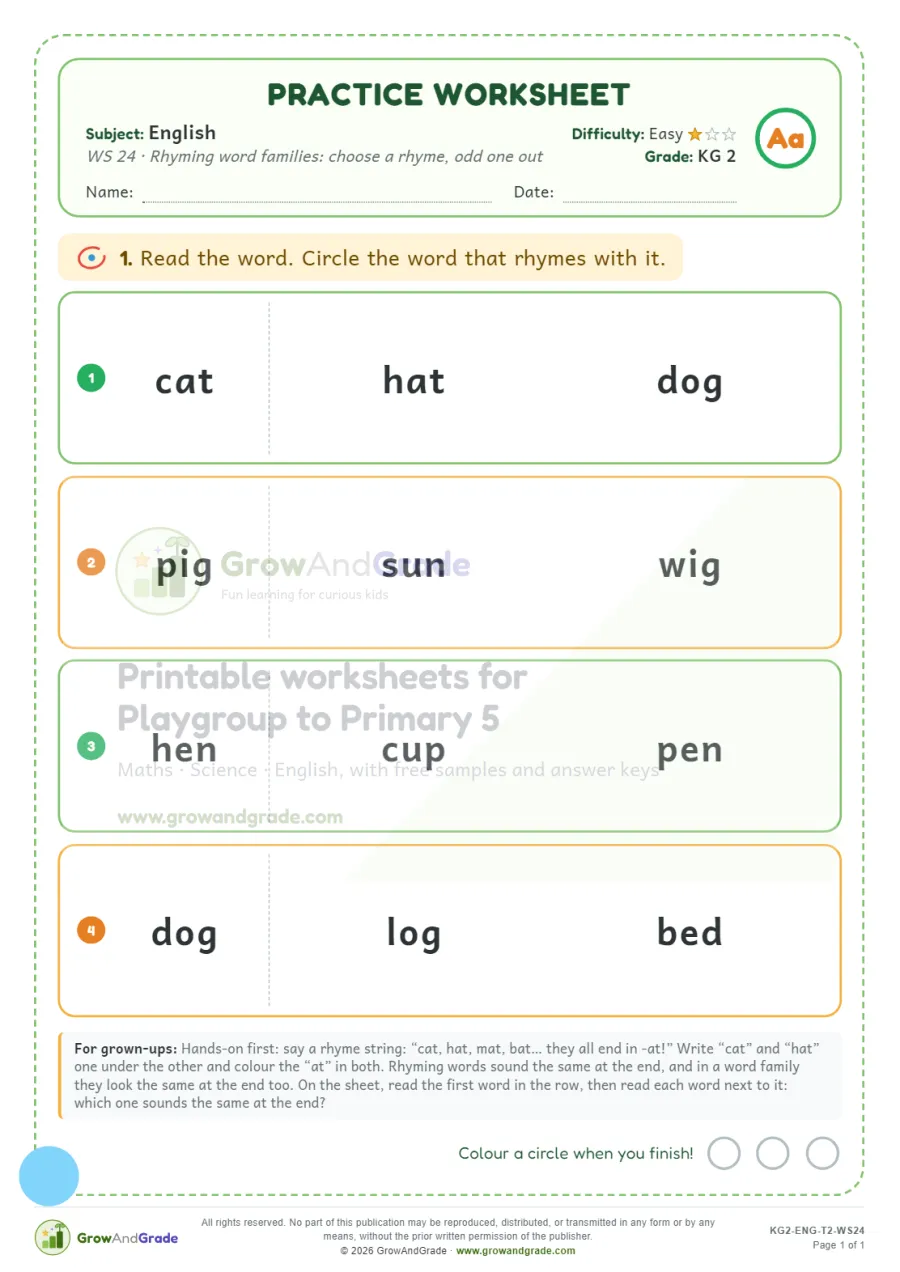
Rhyming word families: choose a rhyme (Easy)
Free download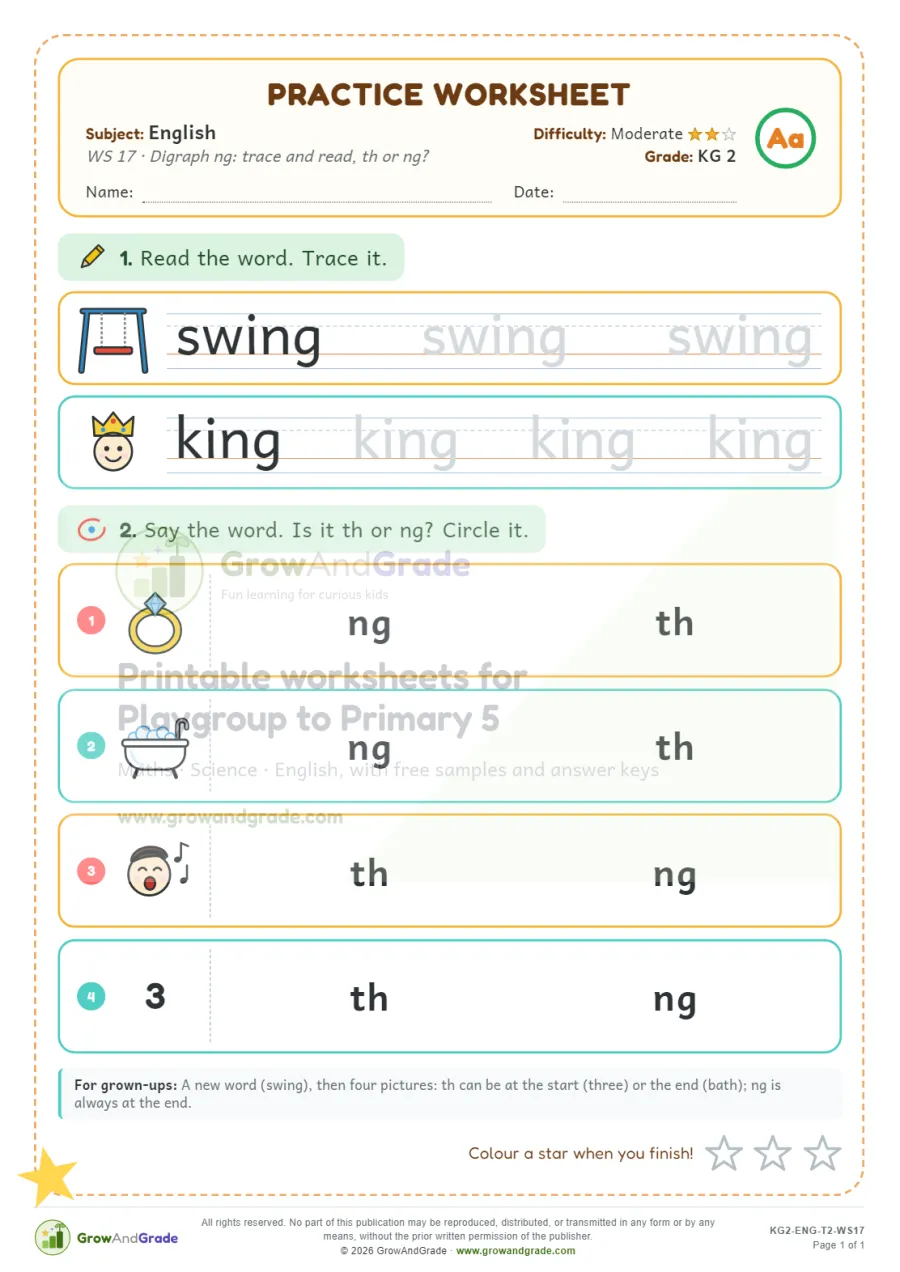
Digraph ng worksheet: th or ng? (Moderate)
Free with accountQuestions parents ask
At what age should my child start learning phonics?
Many children start hearing and playing with sounds around three or four, and most schools begin daily phonics teaching between four and five. Before that, rhymes, songs and noticing first sounds are the best preparation.
What is a CVC word?
A short word made of consonant, vowel, consonant, such as cat, pen or dog. These are usually the first words children read by blending.
My child knows the sounds but can't blend. What should I do?
That's very common. Model it lots: say the sounds slowly, then the word, and let your child copy. Start with stretchy sounds (like m-a-n) which are easier to blend than bouncy ones.
Should I teach capital letters or lower-case letters first?
For reading, lower case is more useful, because most books are written in it. Capitals come naturally alongside, for names and the start of sentences.
How do I know which phonics programme my child's school uses?
Ask the teacher. Most programmes teach the same sounds in a similar order, but using the same actions and names for things at home helps your child.
Sources and further reading
- Department for Education (England), The reading framework: teaching the foundations of literacy
- Education Endowment Foundation, Improving Literacy in Key Stage 1 (guidance report)
- Cambridge Primary English curriculum framework (Cambridge University Press & Assessment)
- GrowAndGrade English curriculum maps for Playgroup to Primary 1