
How to Teach Science to Preschool Children Through Play
Quick answer
Preschool science is about noticing, asking questions and trying things out. Simple play works best: test what sinks or floats, watch ice melt, chase shadows, grow cress, and sort toys or animals into groups. Ask "What do you think will happen?" before you start, and "What did you notice?" afterwards.
Young children are natural scientists. They poke, pour, drop, squash and ask "why?" about everything. Science at this age doesn't mean learning facts by heart. It means building the habits that real scientists use: looking closely, wondering, trying something out and talking about what happened.
The best part is that you already have everything you need at home.
What science looks like for 3- to 5-year-olds
At this age, children learn science by:
- Observing: looking, listening, touching, smelling.
- Comparing: big and small, hard and soft, heavy and light.
- Sorting: putting things into groups and saying why.
- Predicting: guessing what will happen next.
- Talking: describing what they noticed, using new words.
Every activity below practises some of these.
Five easy science activities
1. Sink or float
Fill a bowl or the bath. Collect a few things: a spoon, a cork, a leaf, a coin, a plastic toy, a ball of foil. Before each one goes in, ask: "Will it sink or float?" Then test it. Sort the things into two groups afterwards.
Words to use: sink, float, heavy, light, guess.
2. Melting ice
Put a few ice cubes in different places: a sunny window, the shade, a bowl of warm water. Which melts first? Freeze small toys in ice and let your child rescue them with warm water and a spoon.
Words to use: frozen, melt, cold, warm, water.
3. Shadow play
On a sunny day, go outside and look at your shadows. Can you make your shadow big? Small? Can you hide it? Indoors, use a torch and toys to make shadows on the wall.
Words to use: light, dark, shadow, block, behind.
4. Growing cress
Put damp cotton wool on a saucer and sprinkle cress seeds on top. Keep it damp and check it every day. Children love seeing shoots appear in just a few days, and you can eat the cress in a sandwich at the end.
Words to use: seed, grow, water, shoot, root.
5. Animal sorting
Use toy animals or pictures. Sort them into groups: animals with fur, feathers or scales; animals that live on a farm or in the wild; animals that swim, fly or walk.
Then hand it over: ask your child to sort their own toy animals into groups. Tip them all out on the floor and say, "Can you put all the farm animals together?" or "Which ones have feathers?" Let them explain where each animal goes. If a duck ends up with the fish because "it swims", that's good thinking, not a mistake. Once they're confident, ask your child to invent their own groups too.
Words to use: fur, feathers, scales, farm, wild.
Turning questions into learning
You don't need to know every answer. When your child asks "Why is the sky blue?" or "Where does rain come from?", it's fine to say "Good question! How could we find out?" Look it up together, or try a small experiment.
Three questions that work with almost any activity:
- Before: "What do you think will happen?"
- During: "What can you see? What's changing?"
- After: "Was your guess right? Why do you think that happened?"
What children learn about the world, grade by grade
Here are the science topics our early years worksheets cover.
| Grade | Science topics |
|---|---|
| Playgroup | My body and senses, feelings, animals and their coverings, fruit and vegetables, weather, day and night |
| KG1 | The five senses, healthy habits, animal babies, what plants need, sink or float, hard and soft, living and non-living |
| KG2 | Butterfly, frog and plant life cycles, ice and water, push and pull, magnets, light and shadows, seasons, the Sun, Earth and Moon, recycling |
Common mistakes to avoid
- Giving the answer straight away. Let your child guess first; a wrong guess is part of science.
- Making it too long. Ten to fifteen minutes of hands-on play is plenty.
- Only using worksheets. Use them to talk about and record what you did, not instead of doing it.
- Worrying about "proper" science words. Introduce one or two new words at a time, and use them in everyday talk.
Printable worksheets
Practise this at home or in class. Free worksheets come first, and most come with an answer key.
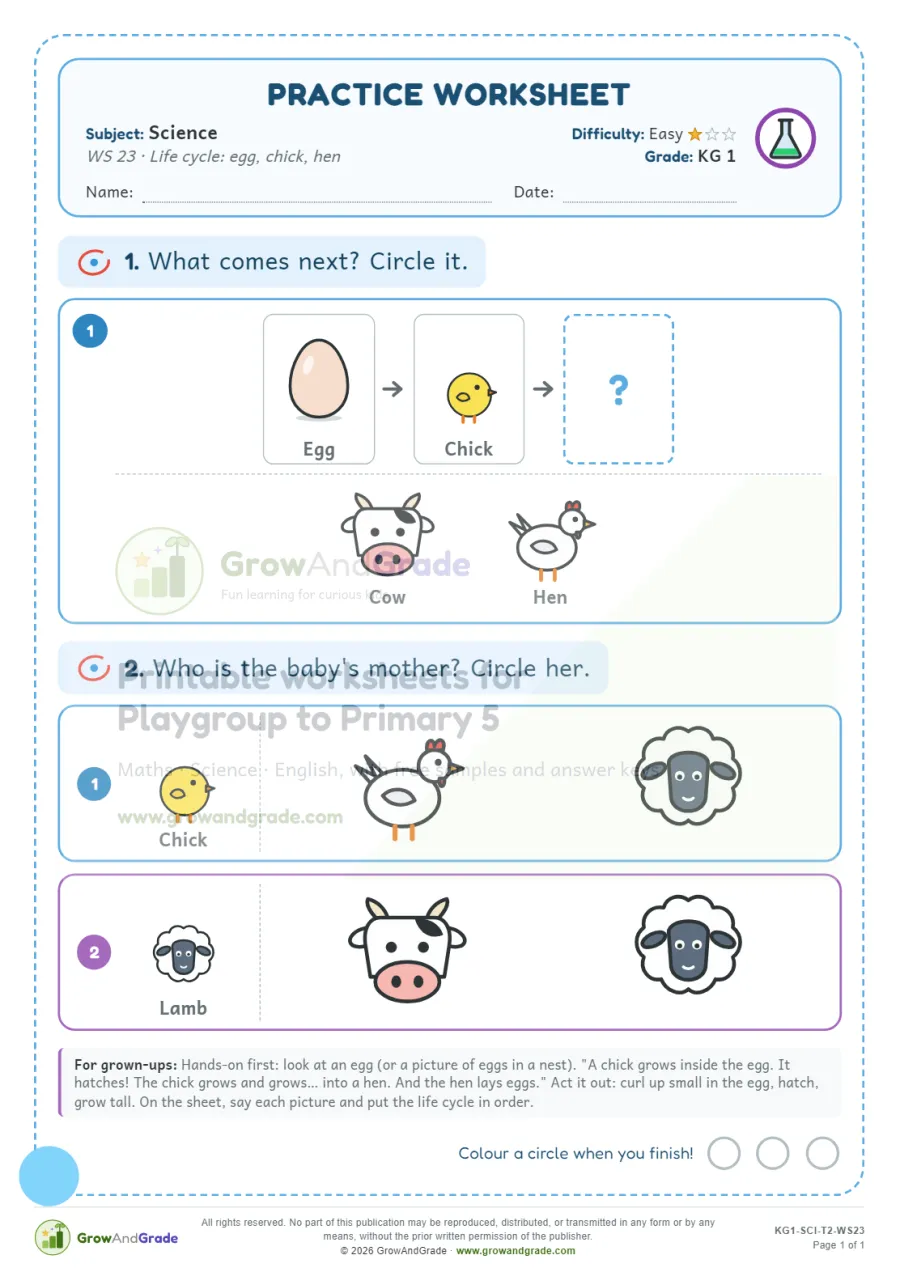
Life cycle: egg, chick, hen (Easy)
Free download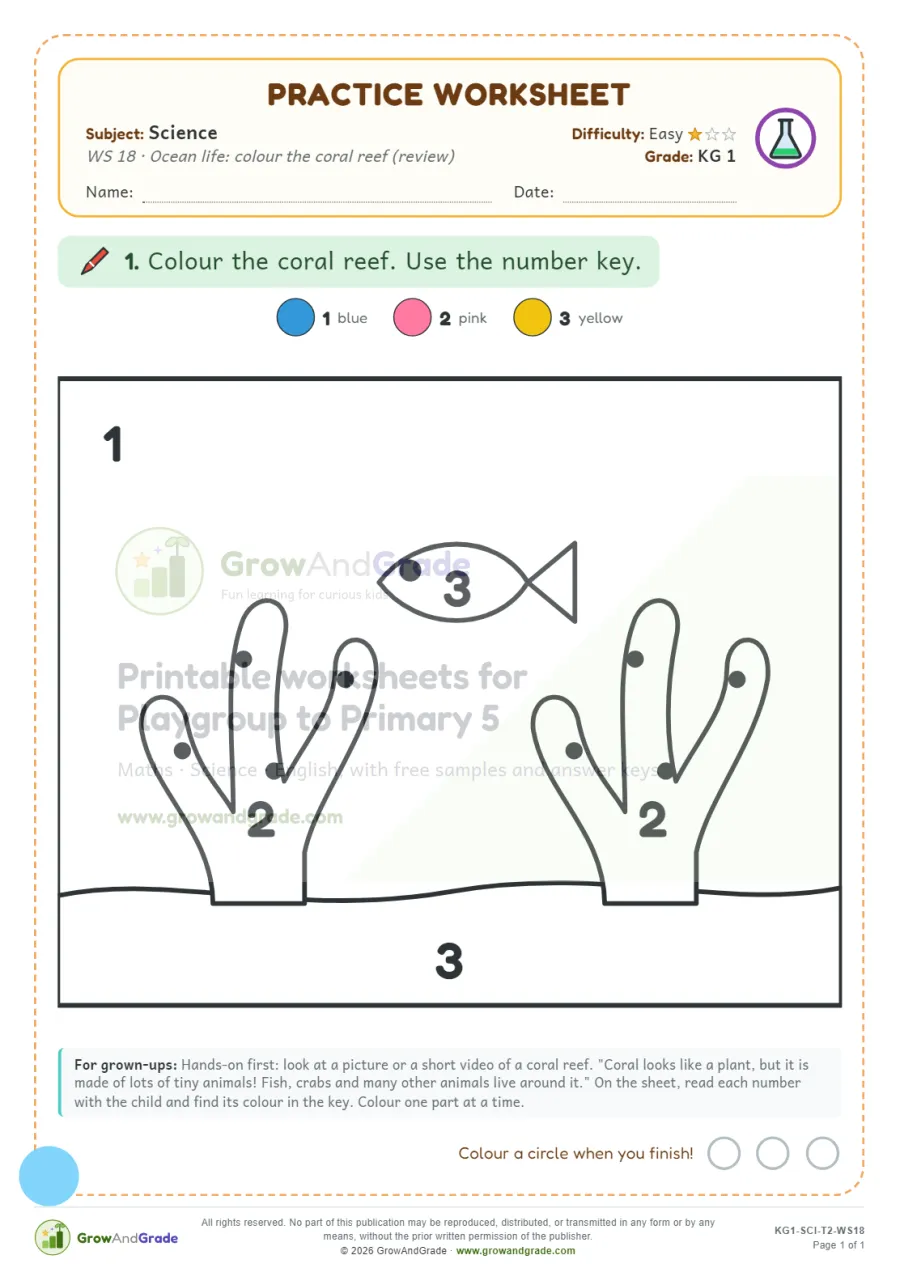
Ocean life: colour the coral reef by number (Easy)
Free download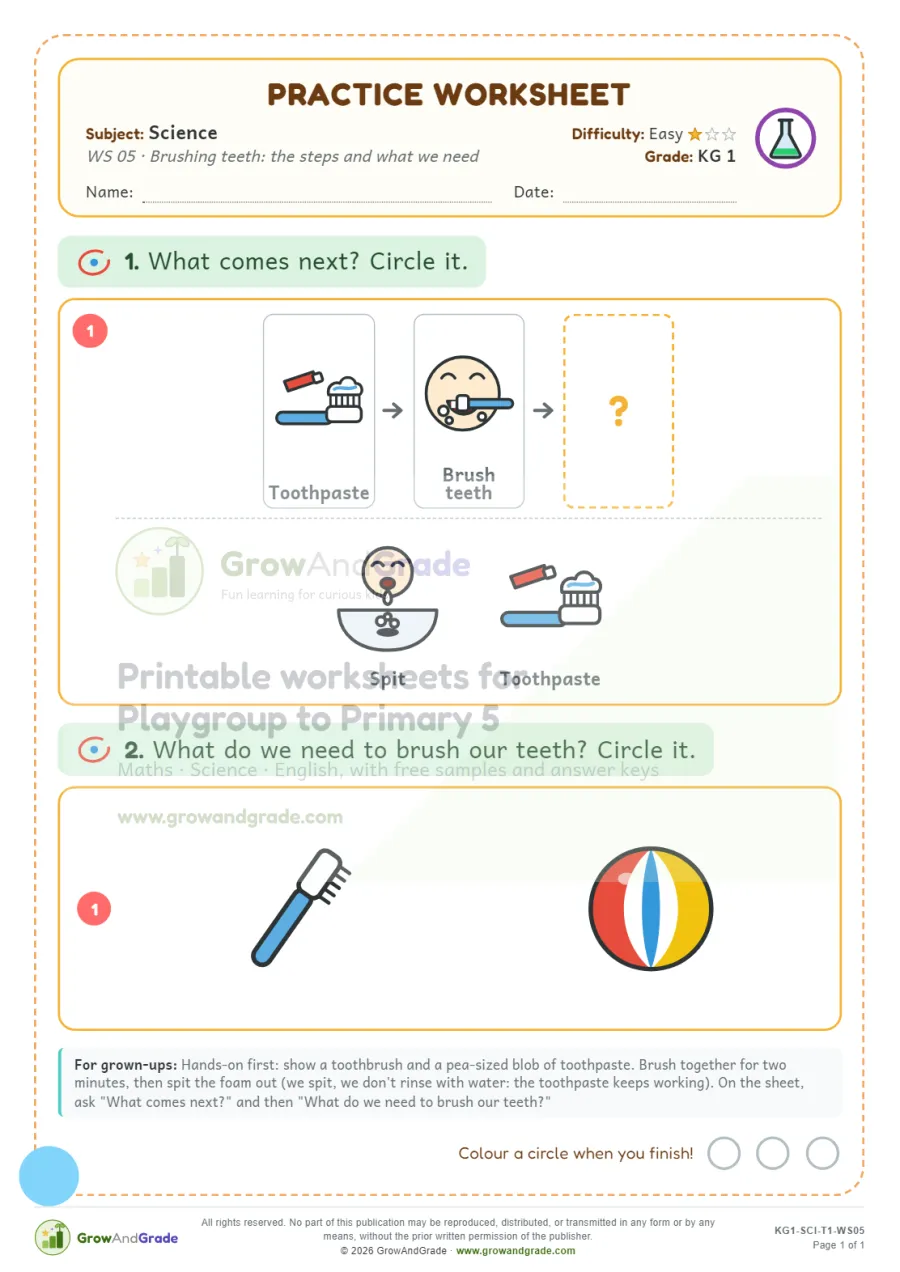
Brushing teeth: the steps in order (Easy)
Free download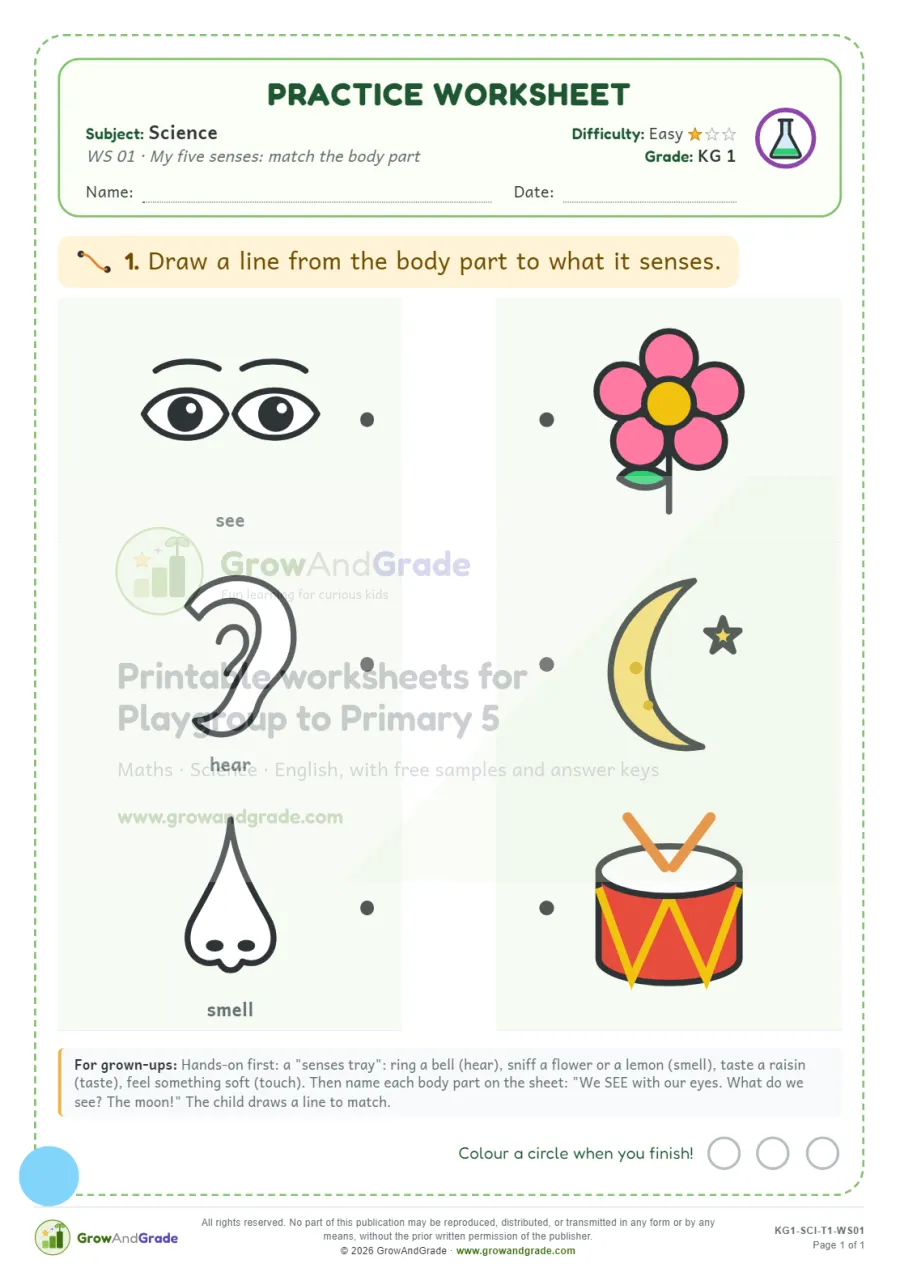
My five senses: match the body part (Easy)
Free download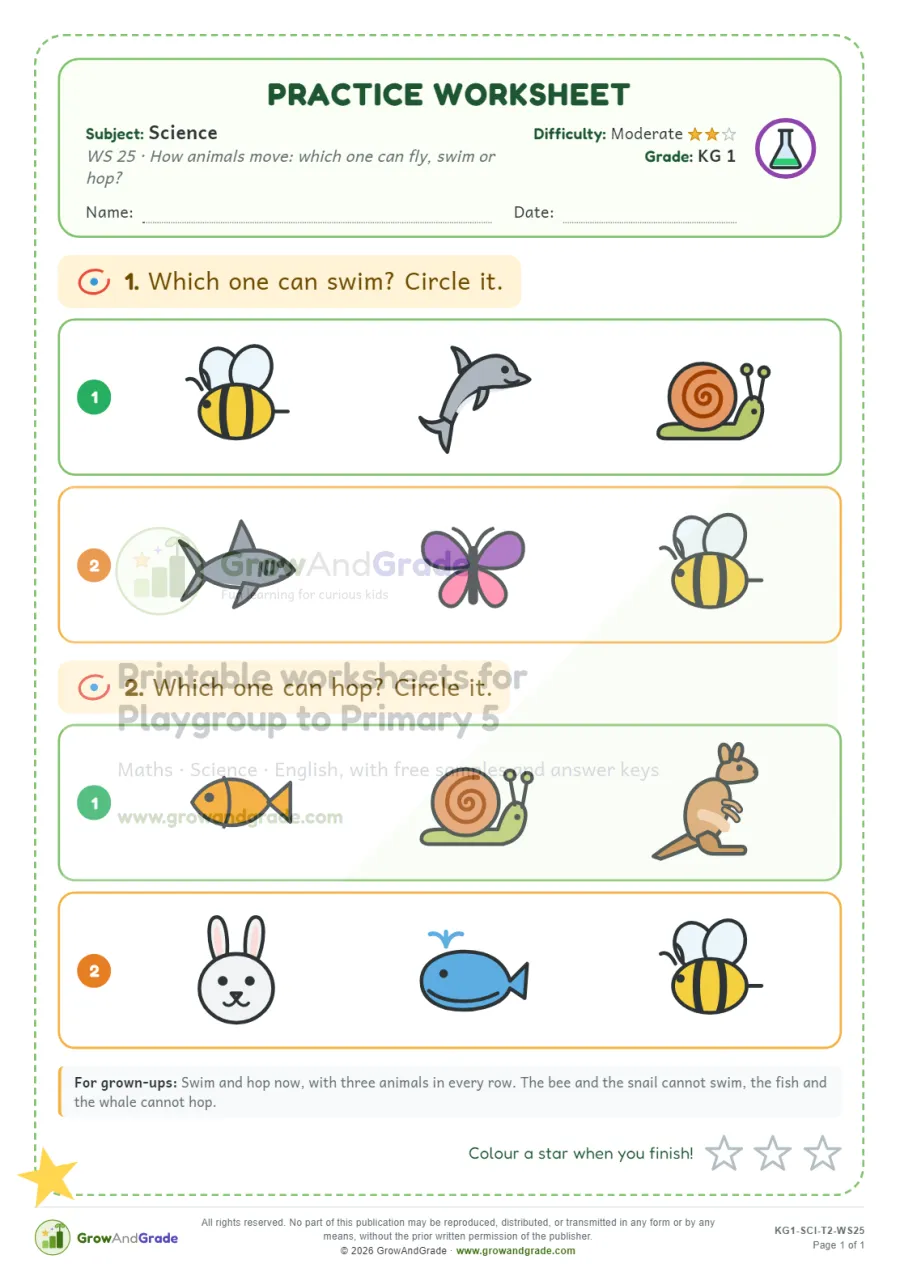
How animals move: which one can fly, swim or hop? (Moderate)
Free with account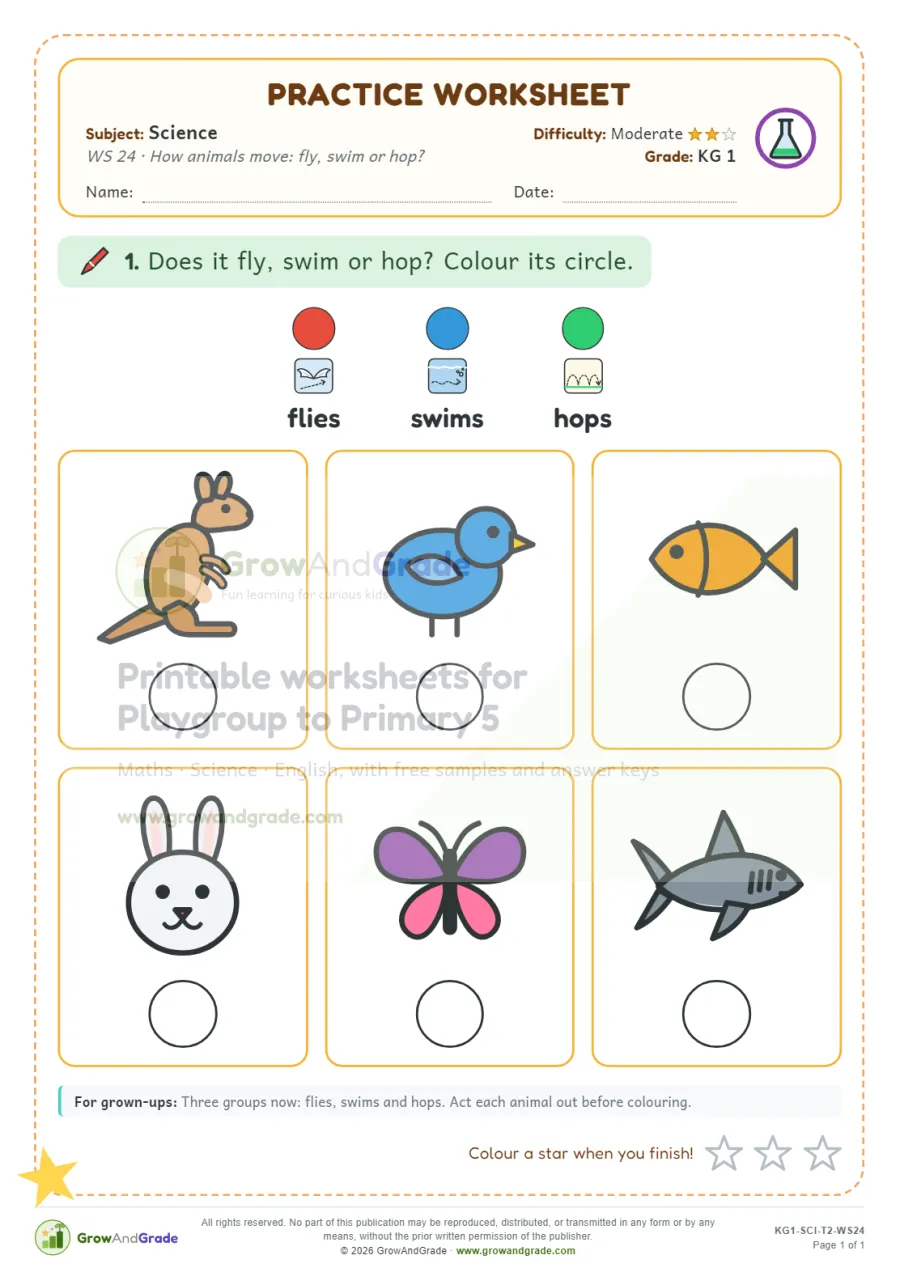
How animals move: fly, swim or hop? (Moderate)
Free with accountQuestions parents ask
At what age can children start learning science?
From the very beginning. Toddlers learn science by exploring with their senses. Simple, guided activities like sink or float work well from about age three.
How can I teach science at home without equipment?
Use what you have: water, ice, a torch, seeds, kitchen spoons, toys and the garden or a park. Most early science needs nothing special.
What are good first science topics for preschoolers?
The five senses, animals, plants and growing, weather, water and ice, and light and shadows. They are all things children can see and touch.
How do science worksheets help young children?
They help children remember and talk about what they explored: drawing the seeds growing, ticking which things floated, or sorting animal pictures. They work best after a hands-on activity.
My child asks "why" all the time. How should I answer?
Celebrate it. Answer simply when you can, and when you can't, find out together. Asking questions is exactly what scientists do.
Sources and further reading
- Department for Education (England), Development Matters, Understanding the World
- Cambridge Early Years curriculum framework (Cambridge University Press & Assessment), Understanding the World
- GrowAndGrade Science curriculum maps for Playgroup to KG2