
What Should a Playgroup Child Learn? A Parent's Guide
Quick answer
In Playgroup, around age three, children mostly learn through play and talk. The main skills are holding a crayon and making lines and circles, recognising colours and simple shapes, counting small groups up to five, noticing letters, and talking about themselves, animals, food and the weather. Confidence matters more than finishing anything perfectly.
Playgroup is the first step, and it is a gentle one. Most children start somewhere between two and a half and three and a half, and the gap between a young and an older Playgroup child can be huge. One child may chat in full sentences while another is still mostly pointing. Both are normal.
So when we talk about what a Playgroup child "should" learn, think of it as a direction rather than a checklist. Below is what our Playgroup worksheets cover, and why each skill matters for what comes next.
Why the Playgroup year matters
At this age children are building the foundations that everything else sits on: strong little hands for writing later, the language to describe what they see, and the habit of looking closely and noticing patterns.
None of this needs to be formal. A three-year-old learns more from sorting the washing by colour with you than from sitting still for twenty minutes. Worksheets work best as a short, happy extra: five minutes, a crayon, and someone to talk to about the picture.
What children learn in Playgroup
Here is a simple overview, based on the topics in our Playgroup worksheets.
| Area | What it looks like at this age |
|---|---|
| Pencil control | Drawing straight lines down and across, slanted lines, waves and circles |
| Letters | Seeing and tracing capital letters, a few at a time, and hearing their sounds |
| Colours | Naming red, yellow and blue first, then more colours |
| Shapes and size | Circle, square, triangle and rectangle; big, medium and small |
| Numbers | Counting 1 to 5, matching one object to one number, simple AB patterns |
| Thinking skills | Same and different, odd one out, matching identical pictures |
| Me and my body | Face, body parts, the five senses, feelings, washing hands |
| The world around me | Farm and wild animals, fur and feathers, fruit and vegetables, weather, day and night |
Early writing starts with lines, not letters
It is tempting to jump straight to writing names. But most three-year-olds don't yet have the hand strength or control for letters, and pushing too early can make writing feel hard.
Instead, start with big movements: lines from top to bottom, lines from left to right, slanting lines, waves and circles. These are the strokes that letters are made from later. A chunky crayon is easier to hold than a thin pencil, and drawing on a big sheet of paper or even a steamy window all counts.
Numbers: counting things, not just saying numbers
Many Playgroup children can "count" to ten out loud, but saying the words is different from counting objects. The real skill is touching one thing for each number: one, two, three.
Keep it small. Counting to five properly is worth more than reciting to twenty. Count stairs, spoons, toy cars and buttons. Ask "How many?" and wait. When your child can count three things and tell you "three" at the end, they have understood something important.
Letters and sounds: just noticing
In Playgroup, children don't need to read. What helps is noticing letters around them and hearing that words start with sounds: "Ball starts with b-b-b." Our Playgroup worksheets introduce the alphabet a few letters at a time, with big shapes to trace and pictures to colour.
Use the letter sound, not only the name. Saying "sss" for snake is more useful for reading later than saying "ess".
Talking about the world
The science side of Playgroup is really about talking and looking: which animals have feathers, which have fur, what we wear when it rains, what we can see at night. Every conversation adds new words, and a rich vocabulary is one of the strongest foundations for reading later on.
How to practise at home
- Keep sessions short: five to ten minutes is plenty at this age.
- Sit with your child and talk about the page together.
- Let them choose the colour, the crayon, which page first.
- Praise effort ("You went all the way to the end of the line!") more than neatness.
- Stop while it is still fun. Tomorrow is another day.
Common mistakes to avoid
- Pushing writing too early. Lines and circles first; letters come later.
- Correcting every wobble. Wobbly lines are how hands learn.
- Too much at once. One page is enough for a three-year-old.
- Comparing with other children. Development at this age varies a lot from month to month.
Printable worksheets
Practise this at home or in class. Free worksheets come first, and most come with an answer key.
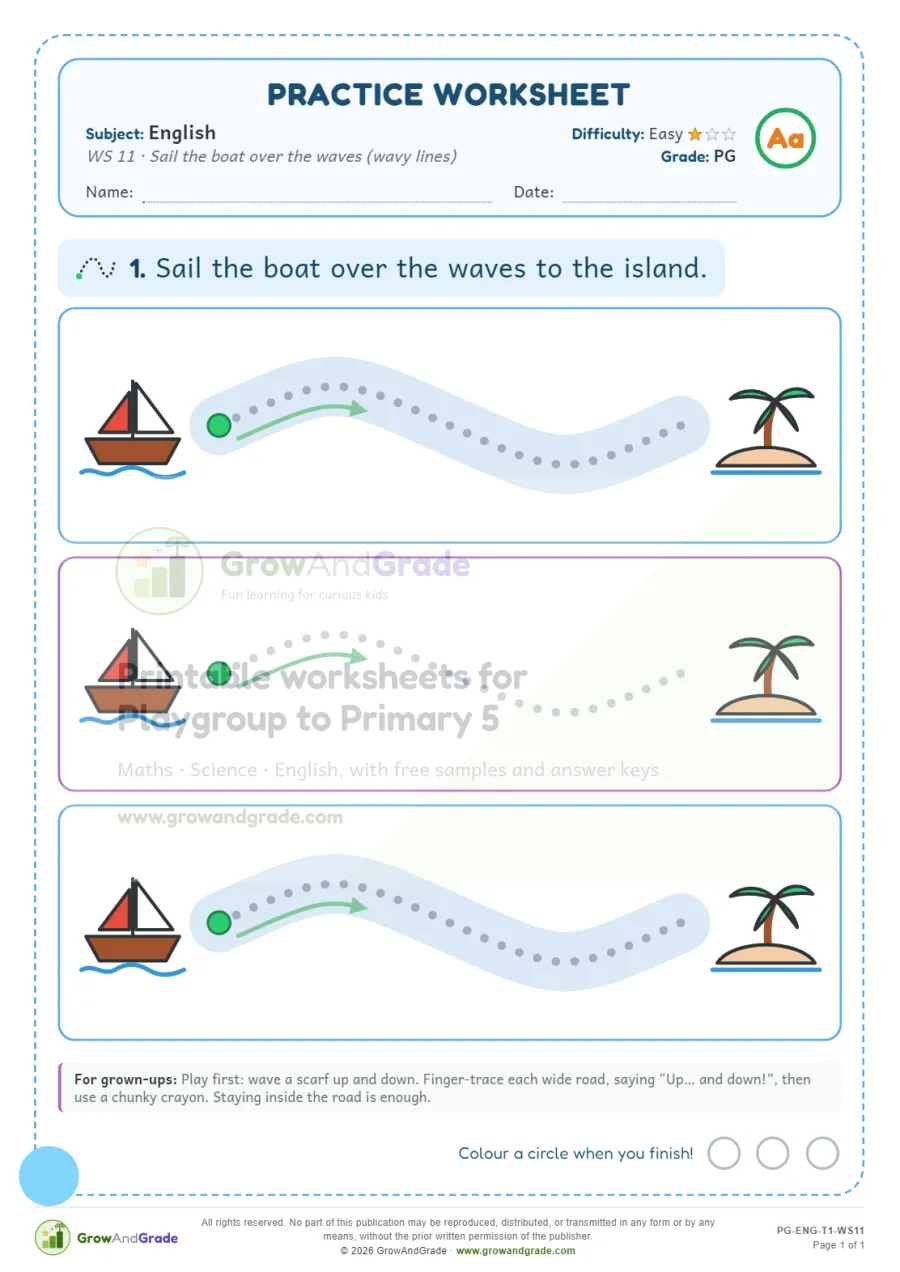
Sail the boat over the waves: wavy line tracing (Easy)
Free download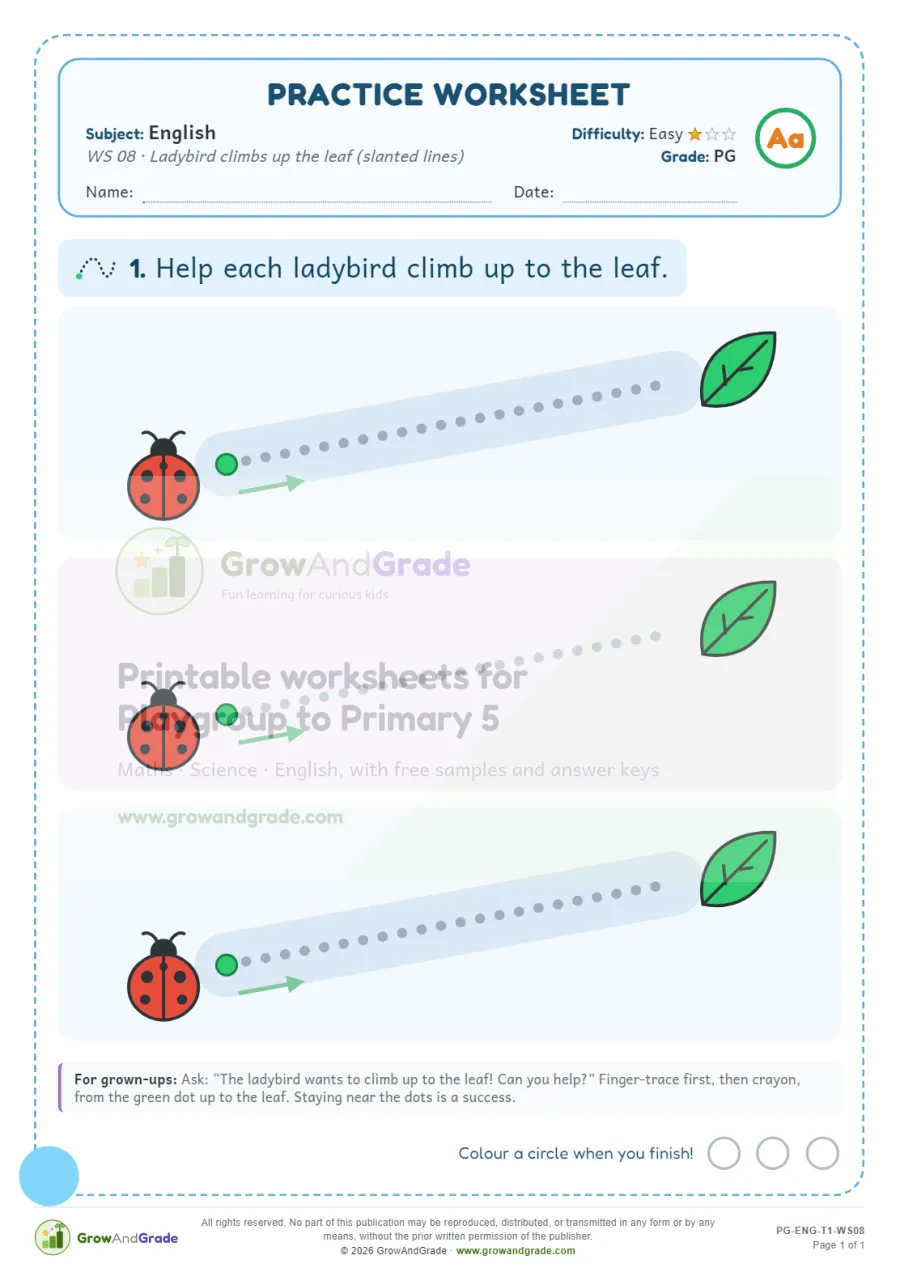
Help the ladybird climb up: slanted line tracing (Easy)
Free download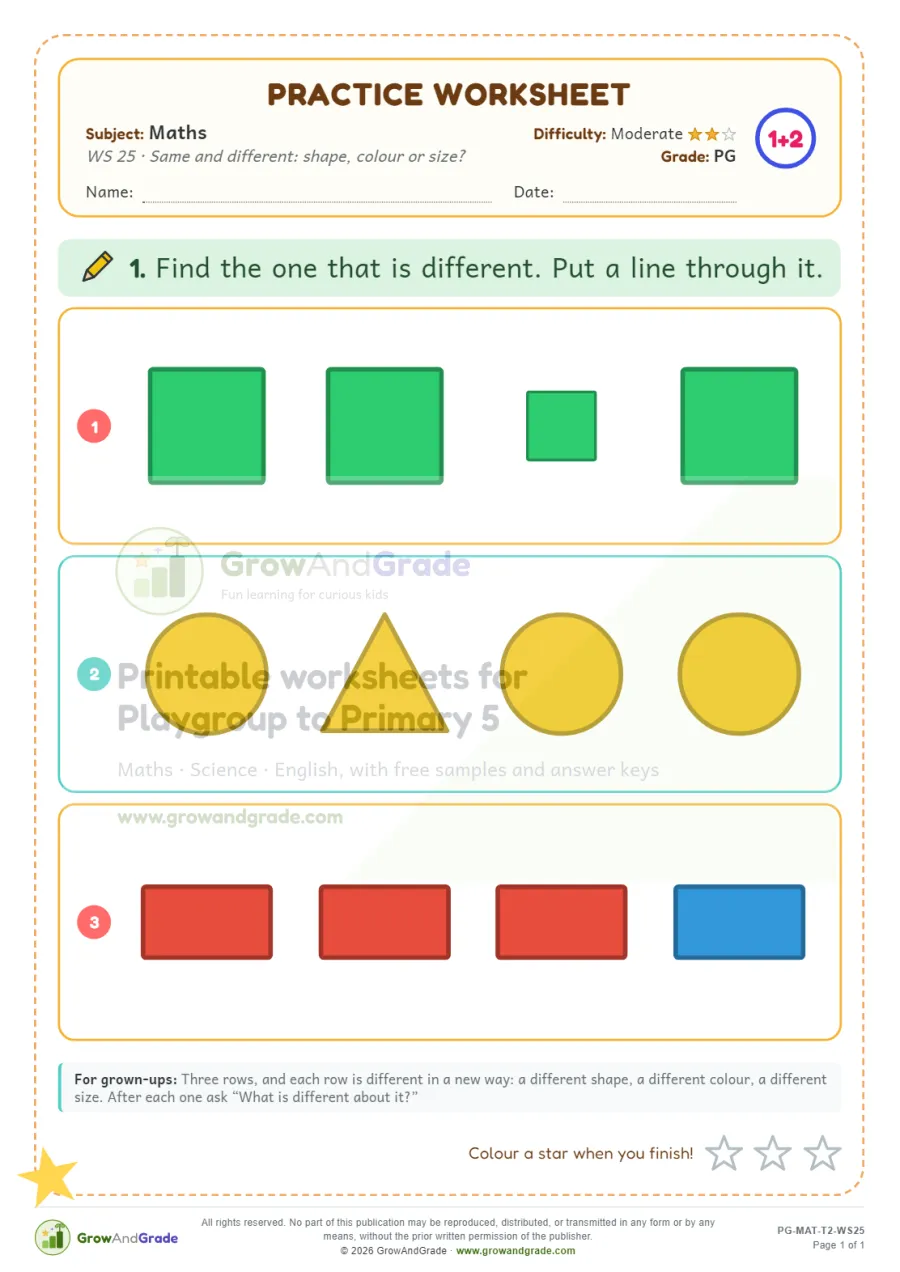
Same and different: shape, colour or size? (Moderate)
Free with account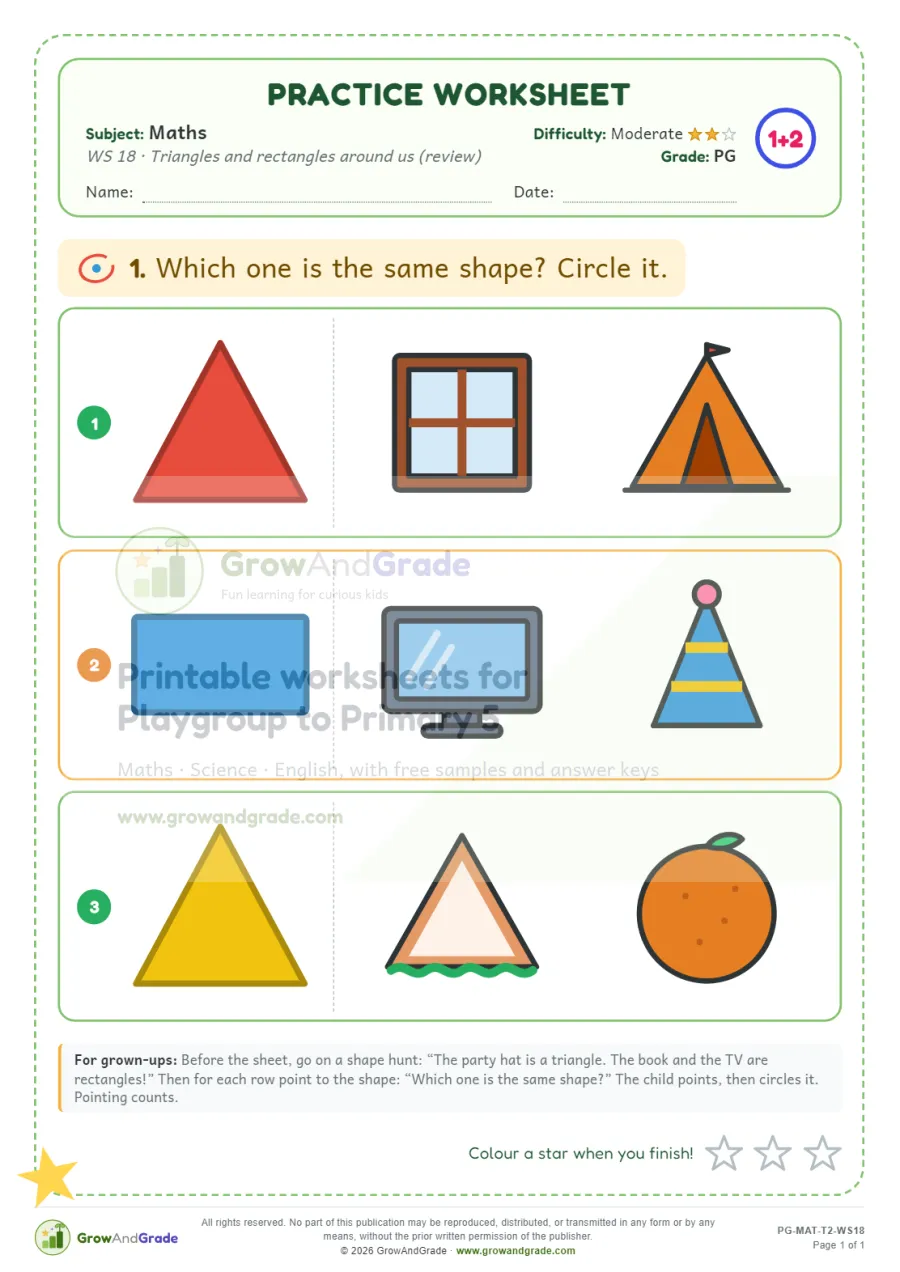
Triangles and rectangles around us (Moderate)
Free with account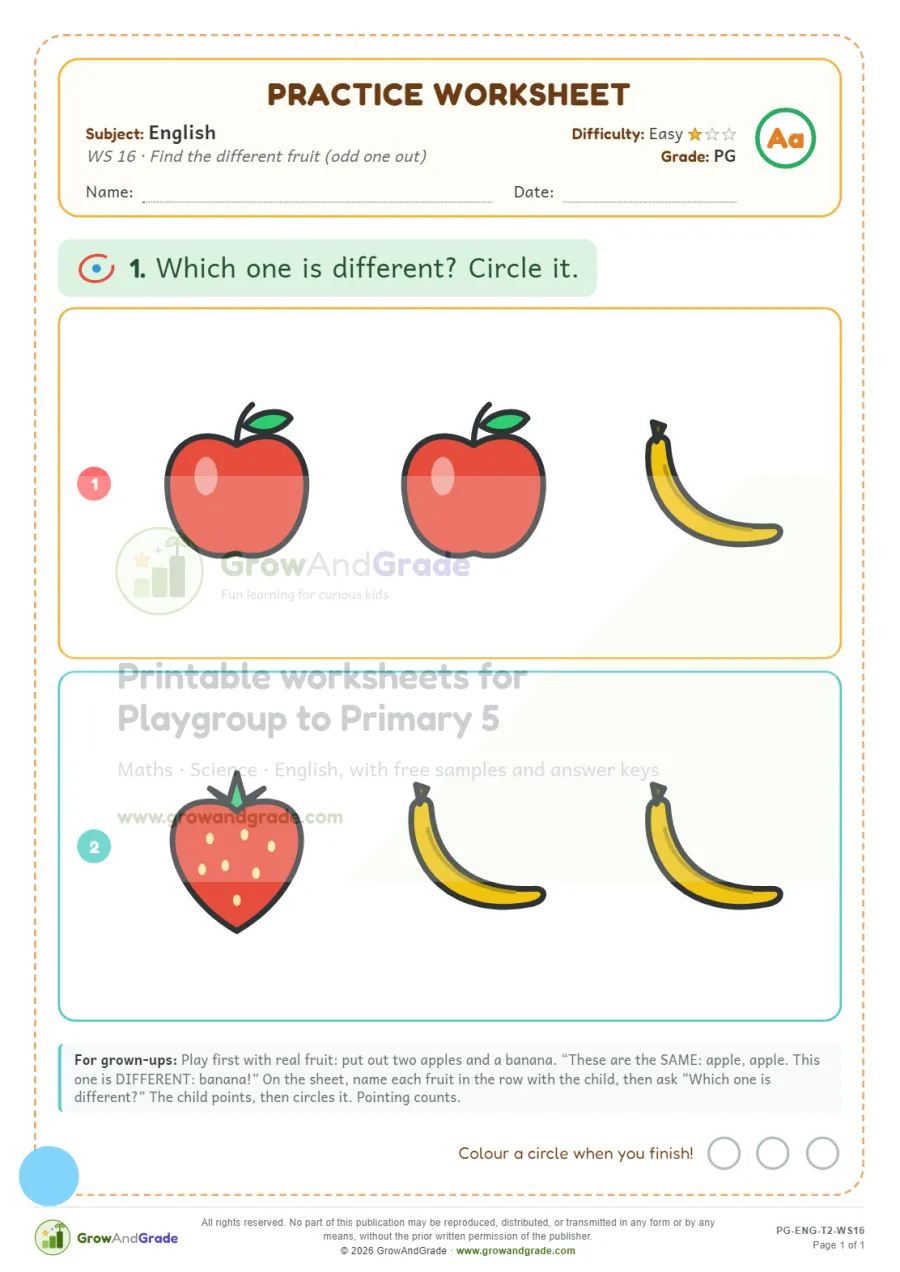
Find the different fruit (Easy)
Free download
This is a circle: colour the circles (Easy)
Free downloadQuestions parents ask
At what age does Playgroup start?
Usually between two and a half and three and a half, depending on the school or nursery. Children develop at very different rates in this year, so focus on your child's own progress.
Should my Playgroup child be able to write their name?
Not yet. Most children write their name later, in Kindergarten. In Playgroup, drawing lines, circles and simple shapes builds the hand control they will need.
How long should a three-year-old spend on a worksheet?
About five to ten minutes, with you sitting alongside. Stop as soon as attention fades; a short, happy session is better than a long one.
Do Playgroup children need to know the alphabet?
No. It helps if they start to notice letters and hear the first sound in a word, but knowing the whole alphabet comes later.
My child doesn't like colouring. Is that a problem?
Not at all. Try painting, play dough, drawing in sand or chalk on the ground. Anything that strengthens little hands helps.
Sources and further reading
- Department for Education (England), Development Matters: non-statutory curriculum guidance for the early years foundation stage
- Cambridge Early Years curriculum framework (Cambridge University Press & Assessment)
- GrowAndGrade Playgroup curriculum map (the units our Playgroup worksheets follow)